

Personalized Family Vacation Shirts With Names: 2026 Ideas
Table of Contents
- 2026 Family Vacation Shirt Ideas That Go Beyond the Basic Group Tee
- Funny Family Vacation Shirt Sayings That Actually Get Worn Again
- How to Design Matching Family Shirts Without the Cliché Look
- Best Fabric for Custom Vacation Apparel: Cotton vs. Performance Blends
- DIY vs. Professional Printing: What Your Family Group Actually Needs
- Color Coordination Tips for Groups and Sizing That Works for Everyone
- Conclusion
- Frequently Asked Questions
Last Updated: September 17, 2026
2026 Family Vacation Shirt Ideas That Go Beyond the Basic Group Tee
Most family vacation shirts get worn once, photographed, and buried in a drawer, but the best family vacation shirts avoid that fate. That is the fate of the plain group tee. In 2026, the families getting real use out of their matching apparel are the ones building in specific trip details: a year stamp, a destination graphic, a family name.
Year-Stamped and Destination-Specific Designs
The year stamp is the single easiest upgrade. A "Smith Family 2026" design turns a generic tee into a commemorative piece. Add a destination graphic, a mountain range, a wave, a campfire, and the shirt now tells a story.
Three formats work well:
- Year plus name: "The Garcias 2026" in a clean serif font
- Destination plus year: a simple mountain outline with "2026" tucked inside
- Trip itinerary graphic: a list of stops printed small on the back
Funny Family Vacation Shirt Sayings That Actually Get Worn Again
Funny family vacation shirt sayings work when the joke is specific to your group, not a generic pun. The shirts that get reworn are the ones with an inside joke, a family catchphrase, or a line only your crew understands.
- A running joke from last year's road trip
- A phrase your kid says constantly
- A mock family motto ("We Put the Fun in Dysfunction" works because it is self-aware)
How to Design Matching Family Shirts Without the Cliché Look
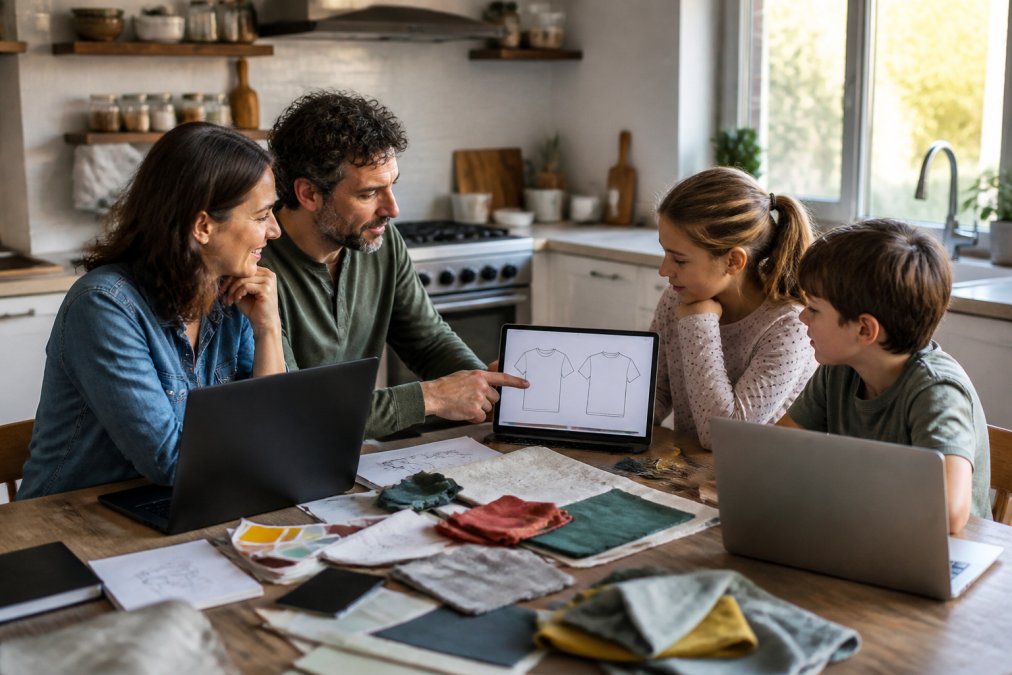
Designing matching family shirts without the cliché look comes down to restraint. Pick one focal point, one font family, and one color palette. Then stop.
Font Selection and Graphic Placement
Font selection is where most designs fall apart. Two fonts maximum: one for the main text, one for accents.
- Sans-serif fonts read cleanly at small sizes and work for names
- Script fonts add personality but get hard to read below two inches tall
- Serif fonts suit year stamps and formal reunion designs
Best Fabric for Custom Vacation Apparel: Cotton vs. Performance Blends
The best fabric for custom vacation apparel depends on the trip, the print method, and who is wearing it. Cotton wins for comfort and print quality. Performance blends win for heat, sweat, and repeated washing. But the real decision happens at the fabric-weight level, not the fiber level, and that is where most family orders go wrong.
Reading the Fabric Spec Before You Order
Every custom apparel listing includes a fabric weight, usually in ounces per square yard (oz/yd²) or grams per square meter (GSM). Here is how the numbers translate to a family vacation shirt:
- 4.0-4.5 oz/yd² (135-150 GSM): Lightweight. Best for beach trips and hot-weather destinations. Prints can feel thin on dark colors.
- 5.0-5.5 oz/yd² (170-185 GSM): The standard retail tee weight. Good all-around choice for photos, theme parks, and reunions.
- 6.0-6.5 oz/yd² (200-220 GSM): Heavyweight. Holds shape well, feels substantial, but runs hot in direct sun.
Cotton vs. Blends vs. Performance: A Working Comparison
| Fabric | Typical Weight | Best For | Print Feel | Care Reality |
|---|---|---|---|---|
| 100% cotton (ring-spun) | 4.3-6.1 oz/yd² | Photos, indoor events, mild weather | Soft, matte, vintage look on dark colors | Wash cold, expect 3-5% shrink on first wash |
| Cotton-poly blend (50/50 or 60/40) | 4.5-5.6 oz/yd² | Everyday wear, family photos, mixed-age groups | Slightly crisper, brighter whites | Wash cold, holds shape and color longer than cotton |
| Tri-blend (cotton/poly/rayon) | 3.8-4.5 oz/yd² | Fashion-forward designs, adult-only groups | Very soft, heathered look, muted colors | Delicate; can pill with heavy washing |
| 100% performance polyester | 3.8-4.5 oz/yd² | Beach, hiking, hot climates, active kids | Smooth, vivid, moisture-wicking | Machine wash, dries fast, resists wrinkles |
For a beach trip, a performance polyester or poly-rich blend keeps everyone cooler and dries faster after the pool. For a reunion photo where comfort and a soft hand matter more than sweat management, ring-spun cotton gives the best feel. A moisture-wicking option also helps if your group is spending long days outdoors in humidity.
The Sustainable Fabric Angle Most Guides Skip
Standard cotton is water-intensive to grow and conventional polyester is petroleum-based. If your family cares about the environmental footprint of a shirt that may only be worn a handful of times, there are now mainstream alternatives that print well:
- Organic cotton (certified by USDA organic standards or GOTS): Grown without synthetic pesticides. Prints similarly to conventional cotton but typically costs more per unit.
- Recycled polyester (often labeled rPET): Made from post-consumer plastic bottles. Performs like standard polyester for moisture-wicking and print vividness.
- Cotton-recycled poly blends: A middle ground that softens the hand feel while reducing virgin material use.
Mixing Fabrics Within One Order
A common mistake is ordering one fabric for the whole group. If grandma runs cold and the kids run hot, mix fabrics by person. The design stays identical; only the garment changes. Two rules keep a mixed-fabric order looking cohesive:
- Match the color code, not just the color name. "Heather gray" on a cotton tee and "heather gray" on a performance polo can be visibly different shades. Ask the printer for the exact Pantone or hex reference for each garment.
- Match the print method to the fabric. Screen printing works on cotton and blends; DTG (direct-to-garment) works best on 100% cotton; sublimation only works on polyester. If half the group is in cotton and half in performance poly, the printer may need two different print methods, which affects both cost and turnaround.
DIY vs. Professional Printing: What Your Family Group Actually Needs
Professional printing is the better choice for most family groups of 10 or more. DIY works for very small runs where the design is simple, the stakes are low, and someone in the family actually enjoys the craft. The decision comes down to three variables: quantity, design complexity, and how long you need the print to last.
The Real Cost of DIY Iron-On Transfers
DIY looks cheap at the sticker price, but the per-shirt cost climbs once you account for materials and failure rate. A typical home setup for a family of six includes:
- Inkjet printable heat-transfer paper: roughly $0.75-$1.50 per sheet, and most designs need one sheet per shirt
- Blank shirts: $4-$10 each depending on quality and source
- A home iron or heat press: $0 if you already own an iron, $100-$250 for an entry-level heat press
- Time: 10-20 minutes per shirt for cutting, positioning, and pressing
What Professional Printing Actually Costs
Professional pricing is tiered, and the per-shirt cost drops sharply as quantity rises. The pattern across most custom apparel providers is:
- Print-on-demand (no minimum): Highest per-unit cost, often $18-$30 per shirt, but you can order one and see it before committing.
- Screen printing (typically 12+ minimum): Setup fees apply per color per location, but per-shirt cost drops to roughly $8-$15 at 24 pieces and lower at 50+.
- DTG / digital printing: No setup fee, better for full-color or photo designs, per-shirt cost usually between screen printing and print-on-demand.
Individual Personalization on a Bulk Order
Custom apparel providers like RushOrderTees' custom printing guide note that bulk ordering and individual personalization can happen together. That means each person gets their own name or role on the same shared design, "Mom," "Dad," "Grandma," or each kid's first name, without paying a separate setup fee per person. This is the single biggest advantage professional printing has over DIY: personalization is a data change, not a new screen.
A Simple Decision Framework
| Situation | Best Method | Why |
|---|---|---|
| 1-3 shirts, simple one-color design, low stakes | DIY iron-on | Cheapest upfront, and failure is not catastrophic |
| 1-5 shirts, full-color or photo design | Print-on-demand | No setup fee, no minimum, good color reproduction |
| 6-11 shirts, one or two colors | DTG or short-run screen print | Balances setup cost against per-unit price |
| 12+ shirts, one or two colors | Screen printing | Lowest per-shirt cost once setup is amortized |
| 12+ shirts, full-color or photographic | DTG | No per-color setup, handles gradients and photos |
Color Coordination Tips for Groups and Sizing That Works for Everyone
Color coordination starts with one anchor color and one accent. Pick a base everyone can wear, then use the accent for names and graphics.
Group ordering tips that prevent headaches:
- Choose a unisex fit as the default so sizing is predictable
- Offer youth and toddler sizes in the same design
- Check the size chart per garment type, since a youth large is not an adult small
- Order one extra of the most common size for exchanges
Conclusion
The difference between a shirt that gets reworn and one that gets buried comes down to three choices: a specific design, the right fabric, and a print method that lasts. Get those right, and your matching apparel becomes commemorative gear instead of a one-time costume.
Frequently Asked Questions
What are some ideas for personalized family vacation shirts with names?
Popular options include year-stamped designs like 'Smith Family Vacation 2026,' destination graphics with each person's name and role, and nickname-only shirts for a more casual feel. You can also add trip-specific details such as the itinerary or a map outline.
How do I choose the right font for personalized family shirts?
Pick a font that matches your trip's personality: script fonts for beach or romantic getaways, bold block letters for road trips, and rounded fonts for camping themes. Keep names in a contrasting font from the main design so they stand out. Test the font at the actual print size before ordering, since thin scripts can disappear on dark fabrics. Most design software lets you preview mockups, which helps catch readability issues early.
What should I include on personalized family vacation shirts beyond names?
Add the vacation year, destination, and a short family motto or inside joke. You can also include each person's role (Mom, Dad, Junior) or a fun title. Trip itinerary details like dates or a city list work well on the back of the shirt. Keep the front simple with one focal point, and save the extra details for the back so the design stays clean and wearable after the trip ends.
Are matching family vacation shirts still popular in 2026?
Yes. Marketplace listings on Etsy and Amazon show strong demand for 2026-themed personalized apparel, with designs featuring year stamps, custom family names, and destination graphics. Custom apparel providers also note that matching shirts help families keep track of each other in crowded vacation spots. The trend has shifted toward subtle, wearable designs rather than loud novelty prints, so shirts get worn long after the trip.