

How to Choose Family Reunion T-Shirt Colors
Table of Contents
- Why Shirt Color Is Your First Decision
- Best Family Reunion T-Shirt Color Combinations
- Color Psychology and Group Photography
- How to Choose T-Shirt Sizes for a Group
- Custom Family Reunion Shirt Printing Tips
- Inclusive Color Choices for All Skin Tones
- Budgeting and Cost Optimization
- Frequently Asked Questions
Last Updated: September 24, 2026
Why Shirt Color Is Your First Decision
Selecting one shirt color for the entire group accounts for 90% of the decision-making process for successful coordination, according to GoPrintPlus guidance on simplifying custom apparel planning. This single choice cascades through every other decision you'll make. Once you pick the base color, your design options, ink selections, and even budget constraints fall into place automatically.
Start with color. Get that right, and the rest becomes simple.
Best Family Reunion T-Shirt Color Combinations
The best family reunion t-shirt color combinations depend on your event setting and photography goals. For outdoor gatherings, bold, high-visibility colors like royal blue, red, kelly green, and neon yellow ensure family members are easy to spot in group photos. According to CheapTees industry guidance on color selection for large outdoor events, these colors photograph well and maintain clarity even from a distance.
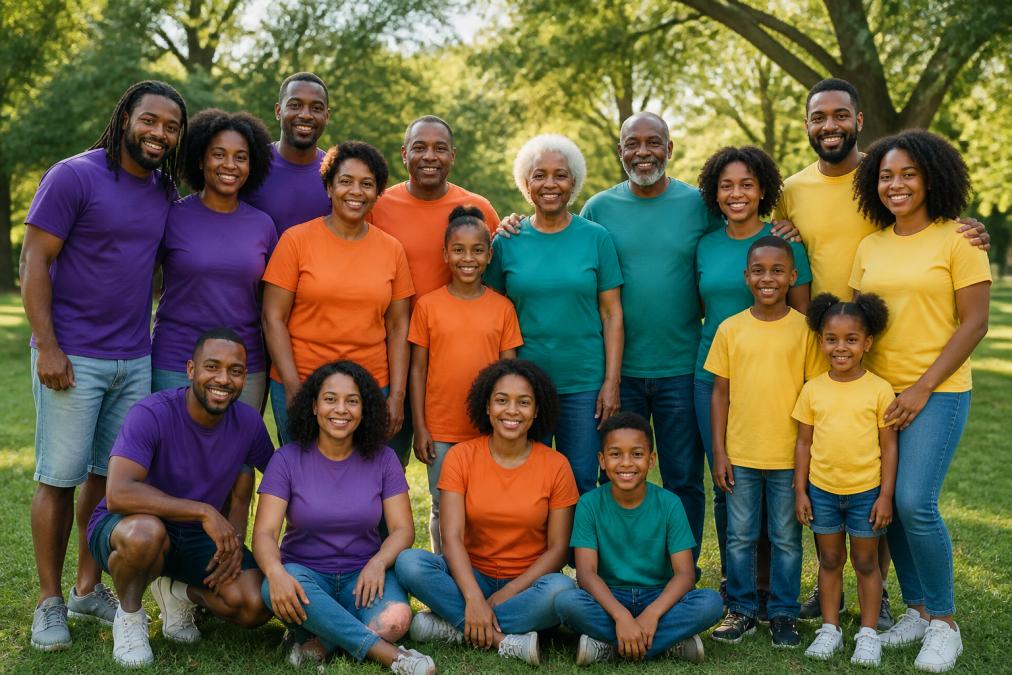
For indoor or more formal settings, neutral base colors work better. Navy, black, heather gray, and white are trending choices because they photograph well in bright sun and flatter a diverse range of body types, according to UberPrints design trends for custom event apparel. These neutral tones create a polished, coordinated look across different age groups.
Here are the top combinations that work:
- Royal blue + white ink, High contrast, reads clearly, works for outdoor and indoor events
- Navy + gold or yellow ink, Elegant, photographs well, flatters most skin tones
- Kelly green + white or cream ink, Bold outdoor choice, excellent visibility
- Heather gray + navy or black ink, Versatile, works for casual and semi-formal events
- Black + neon yellow or white ink, Maximum contrast, perfect for large outdoor groups
The key is contrast. Limiting the number of ink colors used in a design directly correlates to a lower price per shirt, according to Reunly cost-optimization strategies for custom event apparel. A single ink color on a coordinating shirt base keeps costs down while maintaining visual impact.
Color Psychology and Group Photography
Warm colors (red, orange) convey energy and togetherness, while cool colors (blue, green) feel calm and stable. Consider your background: green shirts blend into parks, while bold blue or red pops. Against brick, lighter colors like white or cream create better contrast.
Skin Tone Inclusivity: The Real Color Decision
Skin tone inclusivity is not an afterthought, it's the foundation of choosing a color that works for everyone in your family. Different colors complement different undertones, and a color that looks stunning on one person can wash out another.
For warm undertones (golden, peachy, olive), colors that work well include:
- Warm jewel tones: ruby red, warm emerald, sapphire blue
- Earth tones: terracotta, warm bronze, burnt orange
- Warm neutrals: camel, warm gray, warm white
For cool undertones (pink, rosy, ashy), colors that work well include:
- Cool jewel tones: cool emerald, cool sapphire, amethyst
- Cool neutrals: navy, cool gray, bright white, silver
For neutral/balanced undertones, most colors work, but mid-tone saturated colors tend to be safest:
- Navy, heather gray, jewel tones (sapphire, emerald, ruby)
- Avoid very pale pastels and overly saturated neons
Most families have mixed undertones. Test your top color choices on 3-4 family members with different skin tones in natural outdoor light before committing. Use high-contrast ink colors (white or cream on dark shirts, dark on light) to ensure legibility across all complexions. Avoid very pale pastels and overly saturated neons; mid-tone, richly saturated colors, navy, emerald, sapphire, burgundy, warm gray, work best across diverse skin tones.
How to Choose T-Shirt Sizes for a Group
Getting sizing right ensures people will actually wear the shirt again after the reunion, especially critical for multigenerational families where sizing needs vary dramatically.
The Sizing Collection Process
Create a sizing survey asking family members their typical shirt size and preferred fit (standard vs. fitted). Share the vendor's official measurements so people can verify their size. Account for 3-5% shrinkage in 100% cotton shirts by sizing up if unsure. Offer unisex and fitted options separately. Order 2-3 extra shirts in common sizes (M and L) and confirm quantities before production.
Sizing and Color Interaction: A Practical Consideration
Your color choice can actually affect how sizing works for your group. Darker colors (navy, black, forest green) tend to be more forgiving on a range of body types because they don't highlight contours the way lighter colors do. If your family includes people with varying comfort levels about fit, darker colors are a safer choice.
Lighter colors (white, cream, light gray) show every wrinkle and contour, so fit becomes more noticeable. If you choose a light color, ensure your sizing is accurate and that people have the option to size up for comfort.
Bold, saturated colors (royal blue, red, emerald) fall somewhere in the middle, they're forgiving enough for most body types while still being visually striking in photos.
Accessibility Considerations for Sizing
Multigenerational families often include people with different mobility needs, sensory sensitivities, or body variations. Here's how to make sizing inclusive:
-
Offer extended size ranges, Don't limit yourself to S-M-L-XL. Include XS, 2X, 3X, and 4X options if your vendor offers them. Assuming everyone fits into a standard range excludes people.
-
Ask about fit preferences, not assumptions, Some people prefer loose, flowing fits for comfort or mobility reasons. Others prefer fitted cuts. Don't assume based on body type.
-
Consider sensory needs, Some family members may have sensory sensitivities to certain fabric weights or textures. If possible, offer a choice between standard weight and heavier-weight cotton, or ask if anyone has fabric preferences.
-
Provide sizing information in advance, Send the sizing chart at least 3-4 weeks before the order deadline so people have time to measure themselves accurately, especially older family members who may need to reference their preferred fit.
Managing Size Diversity in Your Order
For large families, you'll likely have a wide range of sizes. Here's how to manage that without overcomplicating the order:
-
Create a simple spreadsheet with columns for name, size, and fit preference. Share it with family members and ask them to fill in their information by a deadline.
-
Group sizes by frequency, Count how many people need each size. You'll probably find that M and L account for 60-70% of your order, with S, XL, and 2X making up the rest.
-
Plan for children separately, If your reunion includes children, they may need youth sizes (XS, S) rather than adult sizes. Ask parents to specify their child's usual shirt size.
-
Build in a 10-15% buffer, Order slightly more shirts than your headcount to account for people who didn't respond to the survey, last-minute additions, or size exchanges after the event.
Unisex sizing tends to run large, which works in your favor for group events. You want comfort, not a tight fit. People will actually wear the shirt again if it fits well and makes them feel confident in reunion photos.
Custom Family Reunion Shirt Printing Tips
The printing method you choose affects durability, cost, and how your design looks.
Matching Ink Colors to Fabric
Your ink color choice depends entirely on your shirt color. This is where contrast ratio becomes critical. Dark inks on light shirts and light inks on dark shirts create the best readability.
For high-visibility outdoor events, maintain high contrast by using one light heat transfer vinyl color and one dark heat transfer vinyl color, avoiding low-contrast combinations that make text difficult to read. According to industry guidance, this approach ensures your design remains legible in group photos.
Test your color combination before committing to the full order. Urban Echo Tees can provide detailed color mockups so you see exactly how the ink will look on your chosen shirt.
Design Placement and Visibility
Where you place your design matters as much as what the design is. For group photos, chest placement works best because it's visible even when people are standing shoulder to shoulder. Back placement works if you're photographing from behind, but front and center is the standard choice for family reunions.
Keep your design size moderate. Too small and it disappears in photos. Too large and it overwhelms the shirt. A 4-6 inch design on the chest is the sweet spot for most events.
Font legibility is essential. Sans-serif fonts like Arial and Helvetica read better from a distance than decorative fonts. Keep your text simple and bold. Thin, delicate fonts won't show up in group photos.
Inclusive Color Choices for All Skin Tones
The best family reunion t-shirt colors work for everyone in the family, regardless of skin tone. This is where strategic color selection pays off.
Jewel tones like sapphire, emerald, and ruby complement many skin tones.
Budgeting and Cost Optimization
Budget constraints are real for most family reunions. The good news: smart color choices can significantly reduce your costs.
Frequently Asked Questions
What color should a family reunion shirt be?
The best family reunion t-shirt color depends on your venue and group size. For outdoor events, high-visibility colors like royal blue, red, kelly green, and neon yellow help family members stand out in photos and stay visible. For indoor or formal settings, neutral tones such as white, charcoal, navy, or gray create a cohesive, professional look. Selecting one shirt color accounts for 90% of the decision-making process for successful coordination, so choose your base color before designing any graphics or text.
How do you choose a t-shirt color that looks good on everyone?
Navy, black, heather gray, and white are trending as preferred bases because they photograph well in bright sun and flatter a diverse range of body types. These neutral tones work across different skin tones and age groups, making them ideal for multigenerational gatherings. Avoid very pale or very dark colors in small quantities, as they can wash out some skin tones or create too much contrast. Test your color choice by viewing it on multiple people before placing a bulk order.
Does limiting ink colors really affect the price of custom reunion shirts?
Yes. Limiting the number of ink colors used in a design directly correlates to a lower price per shirt. Using one or two ink colors instead of three or more can significantly reduce your cost per garment. Pair your shirt color with one or two complementary ink colors to keep design impact high while managing expenses. This strategy is especially important when ordering smaller quantities for intimate family gatherings.
What printing method preserves color quality best on reunion shirts?
Our printing methods produce print-ready designs that withstand multiple washes without significant fading, keeping your reunion shirts wearable for years.