

Screen Printing vs Embroidery for Work Shirts
Table of Contents
- Screen Printing vs Embroidery: What Sets Them Apart
- How Screen Printing Works for Custom Apparel
- How Embroidery Creates Professional Logo Placement on Work Shirts
- Custom Work Shirt Branding Costs: Screen Printing vs Embroidery
- Durability of Embroidery vs Screen Printing on Workwear
- Design Complexity and What Each Method Handles Best
- Choosing the Right Method for Your Bulk Order
- Frequently Asked Questions
Last Updated: September 27, 2026
Screen Printing vs Embroidery: What Sets Them Apart
The decision between screen printing and embroidery shapes your budget, timeline, design quality, and garment lifespan. Picking the wrong method wastes money on fading shirts or inflated costs.
Here's what matters: screen printing costs $2 to $5 per shirt for orders of 100 or more with 1 to 4 colors Arklavo's 2026 cost analysis for bulk custom apparel, while embroidery runs $3 to $8 per piece Arklavo's embroidery pricing guide. The price gap widens on polo shirts, where embroidery costs roughly $5 more per piece Yaya Prints comparative pricing for corporate workwear. But cost alone doesn't tell the full story. The real difference lies in durability, design complexity, and the professional image each method projects.
How Screen Printing Works for Custom Apparel
Screen printing forces ink through a mesh screen onto fabric, creating a flat, vibrant image. Each color gets its own screen, and the printer runs the shirt through each screen in sequence, building up the image one color at a time.
Setup costs less per unit in volume because the screen creation expense spreads across all units. Ink opacity is excellent, delivering bold, saturated colors, especially on darker fabrics.
Screen printing struggles with highly detailed, full-color, or photographic designs. Gradients, subtle shading, or intricate detail either get oversimplified or require expensive color separations.
Turnaround time is typically 5-7 business days for large orders. The flat surface finish prevents puckering and keeps designs smooth against the fabric.
How Embroidery Creates Professional Logo Placement on Work Shirts
Embroidery stitches thread directly into fabric, creating a three-dimensional, textured image. Digitization converts artwork into a stitch pattern, a one-time upfront cost that adds value.
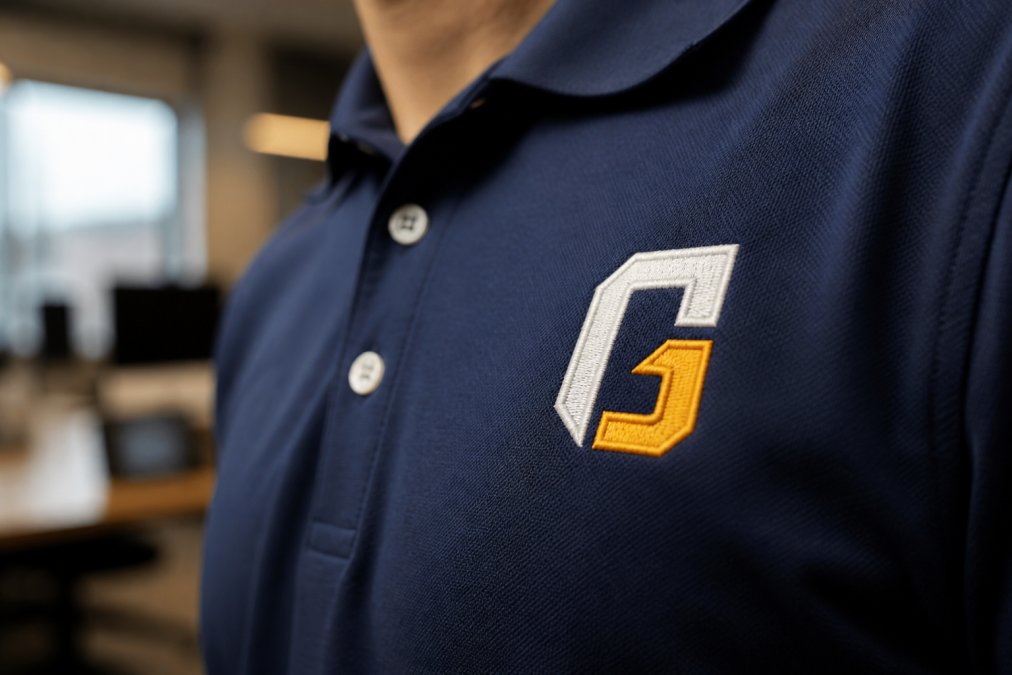
Once digitized, the machine stitches the design onto each garment. Thread count and stitch density determine crispness and detail. For small to medium orders, embroidery becomes cost-effective because you skip multiple screen costs.
Embroidery excels at creating premium brand images and is standard for professional workwear because it conveys quality and durability.
Embroidery struggles with fine detail, thin lines, or full-color images. Thread colors are limited, requiring careful pantone selection. Turnaround times run 10-14 business days because stitching is mechanical and time-intensive.
Custom Work Shirt Branding Costs: Screen Printing vs Embroidery
Budget decisions hinge on order size, design type, and garment lifespan. Professional uniform buyers must calculate cost-per-wear over the garment's actual lifespan, not just per-unit pricing.
Initial Setup and Per-Unit Costs: For bulk orders of 100+ units, screen printing wins on per-unit cost: $2-$5 per shirt versus $3-$8 for embroidery. For smaller runs (15-20 shirts), embroidery becomes competitive. Embroidery's digitization cost ($50-$150) stays fixed regardless of order size, while screen printing requires separate screens for each color, pushing multi-color designs higher.
Immediate Total Cost Examples:
For a 50-shirt order with a simple logo:
- Screen printing: ~$150-$250 setup + $2.50 per shirt = $275-$375 total
- Embroidery: ~$75-$100 digitization + $4 per shirt = $275-$300 total
For a 200-shirt order with the same logo:
- Screen printing: ~$150-$250 setup + $2.50 per shirt = $650-$750 total
- Embroidery: ~$75-$100 digitization + $4 per shirt = $875-$900 total
Long-Term Cost-Per-Wear Analysis (The Overlooked Factor): This is where embroidery justifies its higher upfront cost for workwear. A typical work shirt is worn 200-250 times per year (assuming 4-5 days per week). An embroidered shirt remains visually acceptable for 2-3 years of regular laundering before the brand image degrades enough to warrant replacement. A screen-printed shirt of the same quality typically shows noticeable fading after 18-24 months.
Using a 50-shirt uniform order as an example:
Screen-printed scenario:
Retired Principal Hat – Principal →
- Initial cost: $325 total ($6.50 per shirt)
- Lifespan: 18 months (450 wears per shirt)
- Cost-per-wear: $0.0144 per wear
- Replacement needed at 18 months: $325 again
- 3-year total cost: $650
- 3-year cost-per-wear: $0.0144
Embroidered scenario:
- Initial cost: $287.50 total ($5.75 per shirt)
- Lifespan: 30 months (750 wears per shirt)
- Cost-per-wear: $0.0077 per wear
- No replacement needed within 3 years
- 3-year total cost: $287.50
- 3-year cost-per-wear: $0.0077
Over three years, embroidery costs 47% less per wear despite the higher initial price. For a 200-shirt corporate uniform rollout, this difference compounds significantly: screen printing requires a full replacement cycle within 24 months, while embroidered shirts remain acceptable for 30+ months.
The global custom apparel market reached $54.9 billion to $59.75 billion in 2025 T-Shirt Envy's 2026 market size projections, with strong growth expected, reflecting the rising demand for branded workwear. Businesses increasingly recognize that quality custom apparel drives brand recognition and employee pride, and that durability directly impacts total cost of ownership.
Quick Decision Matrix:
| Order Size | Screen Printing Cost | Embroidery Cost | Better Choice | Reasoning |
|---|---|---|---|---|
| 10-25 shirts | $50-$150 | $40-$100 | Embroidery | Lower total cost; durability less critical for small runs |
| 50-100 shirts | $175-$400 | $200-$400 | Embroidery (if worn regularly) | Cost-per-wear favors embroidery over 2+ years |
| 200+ shirts | $550-$1,200 | $800-$1,600 | Screen printing (if one-time) | Per-unit savings dominate; embroidery wins only if uniform replacement cycle matters |
| Ongoing uniform program | N/A | N/A | Embroidery | Lower replacement frequency reduces 3-year TCO significantly |
When to Choose Screen Printing: One-time event shirts, promotional giveaways, or designs too complex for embroidery. Cost-per-wear is irrelevant because the garment isn't meant to last.
When to Choose Embroidery: Uniforms, recurring branded apparel, or any garment employees will wear 100+ times. The higher initial cost is recovered through extended lifespan and reduced replacement cycles.
Durability of Embroidery vs Screen Printing on Workwear
Embroidered logos outlast screen-printed designs significantly when conditions are right, but "conditions" matter more than most guides acknowledge. The thread is stitched directly into fabric fibers, creating a bond that withstands hundreds of wash cycles. After a year of weekly laundering, embroidered logos remain crisp and vibrant. Screen-printed designs fade faster because ink sits on the fabric surface; repeated washing breaks down the ink-to-fabric bond. After 50-75 wash cycles, you'll notice color fading and potential cracking at edges.
However, fabric weight (measured in GSM, grams per square meter) determines whether embroidery or screen printing will even work without failure. This is where most guides fall short.
Fabric Weight and Embroidery Risk: Embroidery requires sufficient fabric density to anchor thread without puckering or pulling. Lightweight fabrics (under 150 GSM) are vulnerable to embroidery damage. A thin 100% cotton jersey at 130 GSM will pucker around stitched logos because the thread pulls the lightweight fibers inward. Mid-weight fabrics (150-200 GSM) like standard work shirt cotton or cotton-poly blends handle embroidery reliably. Heavy-weight fabrics (200+ GSM) are ideal for embroidery and rarely pucker. Synthetic blends (polyester-cotton) at 160+ GSM present fewer problems than pure cotton at the same weight because polyester fibers resist distortion.
Fabric Weight and Screen Printing Risk: Screen printing adapts to a wider weight range but faces different challenges. Very heavy fabrics (250+ GSM) can cause ink bleeding because the weave is so dense that ink pools on the surface rather than bonding evenly. Lightweight fabrics (under 120 GSM) may show ink show-through on the reverse side. The sweet spot for screen printing durability is 150-220 GSM, where ink penetrates evenly and bonds to fibers without bleeding or ghosting.
Real-World Durability Comparison: For uniforms worn 4-5 days per week in a 150-180 GSM cotton-blend work shirt, embroidery delivers better long-term value despite higher upfront costs. You're replacing embroidered shirts less frequently, typically every 2-3 years with regular laundering. Screen-printed versions of the same shirt may require replacement after 18-24 months as ink fades noticeably. The dimensional quality of embroidery also means it resists wear differently: raised thread catches light and maintains visual impact even as colors subtly shift over time. Screen printing's flat surface shows wear more obviously as fading becomes visible across the entire design.
For occasional-wear branded apparel or one-off event shirts in standard weights, screen printing's lower cost makes sense because durability matters less and the garment lifespan is shorter anyway.
Design Complexity and What Each Method Handles Best
Screen printing excels with bold, graphic designs. Flat colors, clean lines, and simple shapes are screen printing's sweet spot. A company logo with 2-4 colors? Perfect for screen printing. A photographic image or intricate illustration? Screen printing will either lose detail or require so many color separations that costs become impractical.
Choosing the Right Method for Your Bulk Order
Start with three questions: What's your order size? What's your design complexity? How long do these shirts need to last?
Frequently Asked Questions
Is screen printing or embroidery better for professional work shirts?
For professional work shirts, embroidery is frequently preferred because it delivers a premium feel and refined appearance. Embroidery works especially well on polos and outerwear where durability and a tailored aesthetic matter. However, if your design includes complex graphics or full-color artwork, screen printing may be the better choice. Consider your logo design, fabric type, and the image you want to project, embroidery excels at bold, simple designs that maintain quality through repeated washing.
How much does screen printing vs embroidery cost for bulk orders?
For orders of 100 or more units with 1 to 4 colors, screen printing costs $2 to $5 per shirt, while embroidery ranges from $3 to $8 per piece. The price gap between the two methods on polo shirts is approximately $5 per piece. Embroidery carries higher initial setup costs due to digitizing requirements, making it more cost-effective for small to medium-sized orders once you account for those upfront fees. Screen printing becomes more economical at larger volumes.
Which method lasts longer on heavy-duty workwear?
Embroidery typically offers superior longevity on workwear because stitched thread is mechanically fastened to the fabric and resists fading, cracking, and peeling through repeated washing and wear. Screen printing, while durable when applied correctly, can eventually crack or fade with extended use. For uniforms and work apparel that endure frequent laundering and heavy use, embroidery's dimensional, textured finish maintains its appearance and professional look far longer than screen-printed designs.
Can screen printing handle detailed designs better than embroidery?
Yes. Screen printing excels with intricate, full-color, and highly detailed designs because ink can reproduce complex graphics with precision. Embroidery is limited by thread color availability and struggles with fine details, small text, and photorealistic images. If your design features gradients, photographs, or complex artwork, screen printing is the better choice. Embroidery shines with bold, simple logos and monochromatic designs where thread limitations won't compromise the final result.