

Screen Printing vs DTG: Which Method Fits Your Business
Table of Contents
- What Is Screen Printing and How Does It Work?
- What Is Direct-to-Garment (DTG) Printing?
- Screen Printing vs DTG: Key Differences Explained
- DTG vs Screen Printing Cost Comparison for Different Order Sizes
- Best Printing Method for Small Orders: What the Data Shows
- Durability of Screen Printed Shirts vs DTG: Wash Fastness and Longevity
- Choosing the Right Method for Your Custom Apparel Needs
Last Updated: August 26, 2026
What Is Screen Printing and How Does It Work?
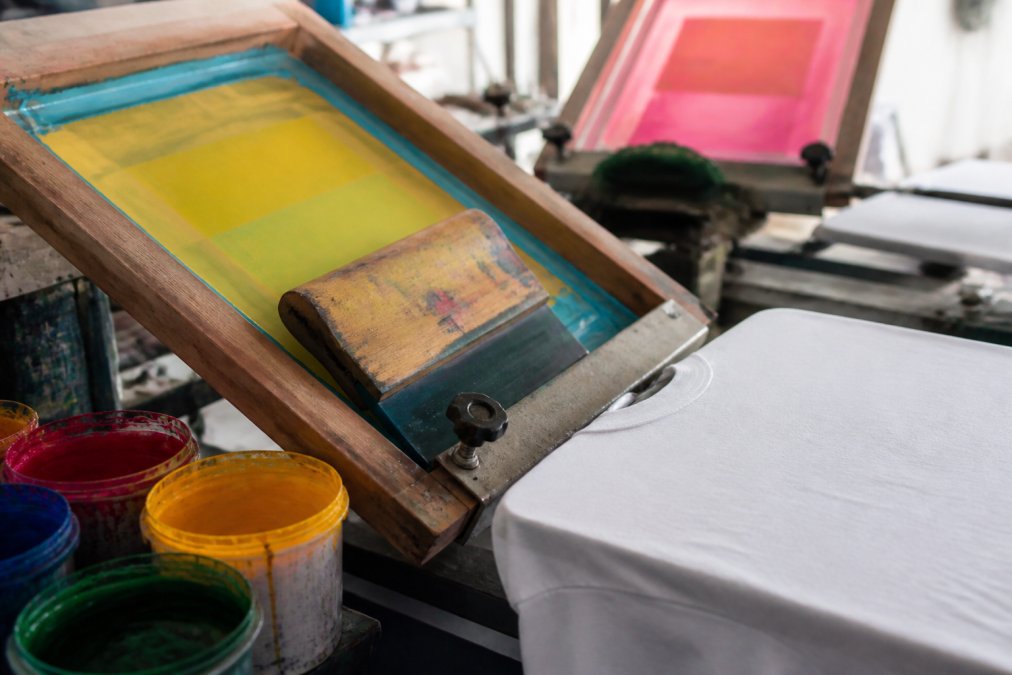
Screen printing is a stencil-based printing method where ink is pushed through a fine mesh screen onto fabric using a squeegee. Each color requires a separate screen and pass through the garment. Your artwork gets separated into individual color layers using spot colors, then burned onto separate screens via an emulsion process. Once screens are ready, ink is forced through the mesh onto the garment and cured in a conveyor dryer, bonding it to the fibers.
A single pass produces deep, vibrant color that doesn't fade easily under normal wear. Properly cured screen prints withstand 60-80 washes before showing significant cracking, according to industry durability standards (aatcc.org). The real advantage emerges at scale: once you've invested in creating screens and setting up the print station, per-garment costs drop dramatically with each additional shirt, making screen printing unbeatable for large orders of 100+ units.
What Is Direct-to-Garment (DTG) Printing?
Direct-to-garment printing applies ink directly to fabric using inkjet technology, similar to a home printer. A DTG printer reads your digital file, processes it through CMYK color profile, and deposits ink droplets onto the garment in a single pass. There's no screen preparation, no color separation, and no minimum order quantities.
The process begins with pre-treatment chemical applied to the garment's surface to improve ink adhesion and color vibrancy. The shirt then moves to the print head, where thousands of nozzles spray ink to recreate your design at high resolution. A heat press or conveyor dryer cures the ink into the fabric fibers.
DTG's flexibility with design complexity is its defining strength. Photorealistic images, gradients, full-color artwork, and intricate details print with equal ease because the technology doesn't require color separation. This makes DTG ideal for print-on-demand workflows, small orders, and visually sophisticated designs.
However, DTG has durability trade-offs. Prints typically last 40-60 washes before noticeable color fade, particularly with white ink on dark garments (peer-reviewed research). The fabric hand feel remains softer than screen printing because DTG uses less ink overall.
Screen Printing vs DTG: Key Differences Explained
The comparison hinges on five core factors: order quantity, design complexity, turnaround speed, cost structure, and final print characteristics.
Design Complexity and Color Handling
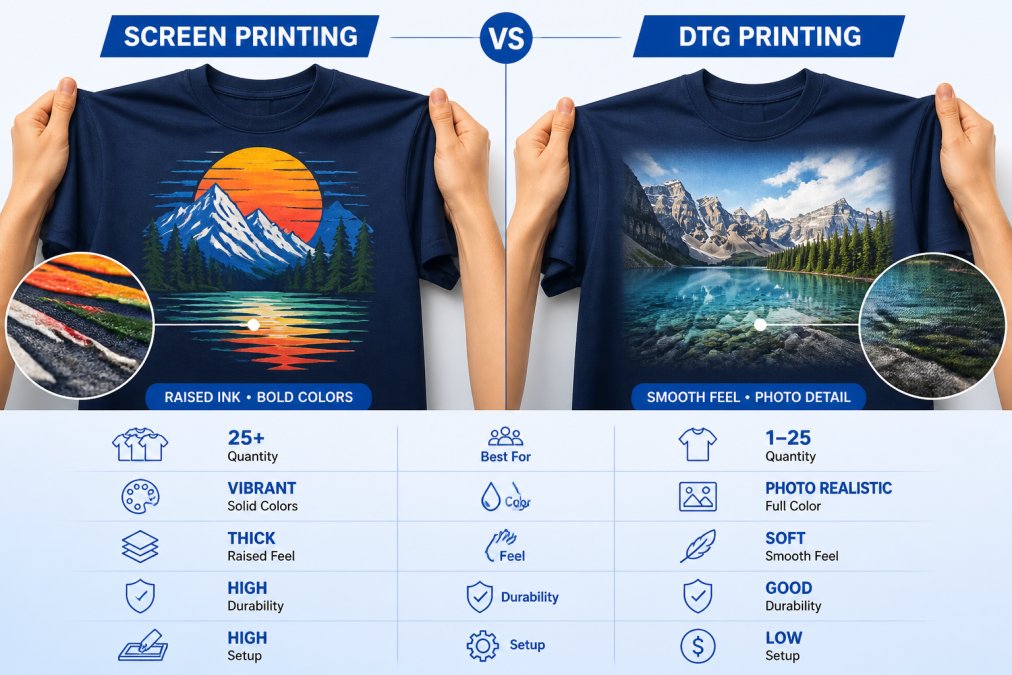
Screen printing thrives with solid colors and simple artwork. A two-color logo prints beautifully and economically. Photorealistic images become impractical, requiring dozens of screens or halftone patterns. DTG handles unlimited colors and photorealistic detail in a single pass, making it the only practical choice for gradients, complex illustrations, or full-color photography.
Turnaround Time
Screen printing requires 2-5 days of setup before production begins. DTG skips setup entirely, with printing beginning within hours. For small orders or rush deadlines, DTG's speed advantage is decisive.
Fabric Compatibility
Both methods work on cotton and cotton blends. Screen printing handles polyester, nylon, and synthetic blends without issue. DTG performs best on natural fibers, particularly cotton, with dull colors and inconsistent adhesion on 100% polyester.
Print Longevity and Wash Fastness
Screen printed garments withstand 60-80 washes with minimal cracking. DTG prints fade noticeably after 40-60 washes. For garments intended as gifts or keepsakes, screen printing's durability advantage matters.
Visual Characteristics
Screen printing produces a raised, tactile print with visible ink saturation. DTG creates a softer print that feels closer to the original fabric surface. The choice often comes down to aesthetic preference and intended use.
DTG vs Screen Printing Cost Comparison for Different Order Sizes
Small Orders (1-25 Units)
For single custom shirts or small batches, DTG is significantly more economical. Screen printing's setup costs typically run $50-150 per color. For a five-color design, you're looking at $250-750 in setup alone. DTG eliminates this entirely, costing approximately $14 per garment for a small-run full-color design versus $17.60 per garment for screen printing with four colors.
Medium Orders (50-200 Units)
The crossover point arrives around 50-75 units. For 100 pieces with a full-color design, screen printing settles at $9.40 per garment while DTG costs $12 per garment. Screen printing edges ahead on price, but DTG remains competitive if design complexity is high or turnaround speed is critical.
Large Orders (500+ Units)
At scale, screen printing becomes unbeatable. Per-garment printing costs drop to $3-6 depending on design complexity, while DTG costs remain around $8-12 per garment regardless of volume.
Best Printing Method for Small Orders: What the Data Shows
For businesses starting out or fulfilling small custom orders, DTG printing has become the dominant choice. According to Fortune Business Insights' 2026 analysis, digital printing methods including DTG hold the second-largest market share in custom t-shirt production and are preferred for detailed and complex designs, various fabrics, multi-color designs, and small orders.
The reasons are straightforward: zero minimum order quantities, no setup costs, instant design-to-print workflow, and the ability to handle photorealistic complexity. When printing 5-50 custom shirts, these advantages compound.
However, "best" depends on your specific constraints. If your designs are simple (two-color logos), you're ordering 200+ units, and you prioritize durability, screen printing delivers better economics and longer garment lifespan. Many successful custom apparel businesses use both methods, routing simple, high-volume orders to screen printing and small, complex, or rush orders to DTG.
Durability of Screen Printed Shirts vs DTG: Wash Fastness and Longevity
Screen Printing Durability
Screen printed garments with properly cured plastisol ink demonstrate strong wash fastness. According to custom apparel industry standards, screen prints typically withstand 60-80 washes before visible cracking appears. The ink bonds deeply into fabric fibers, creating a print that ages gracefully.
DTG Durability
DTG prints typically last 40-60 washes before noticeable color fade. White ink on dark garments fades faster, sometimes showing visible density loss after 20-25 washes. However, 40-60 washes represents substantial durability for most use cases, a garment worn twice per week lasts 4-6 years before significant fading occurs.
Practical Implications
For heirloom-quality items or garments expected to be worn frequently for years, screen printing's longevity advantage justifies its higher upfront cost. For trend-driven designs, seasonal items, or occasional wear, DTG's durability is adequate and its flexibility becomes the deciding factor.
Choosing the Right Method for Your Custom Apparel Needs
The decision comes down to matching your specific requirements to each method's strengths.
Start with these questions:
1. How many units are you ordering? Under 50 units: DTG is almost always more economical. Above 200 units: Screen printing typically wins on cost.
2. What's your design complexity? Simple logos or solid colors: Screen printing excels. Photorealistic images or gradients: DTG is necessary.
3. How quickly do you need delivery? Rush orders (under 5 days): DTG's lack of setup time is decisive.
4. How long should the print last? Keepsakes or frequently worn items: Screen printing's durability advantage matters. Seasonal or occasional wear: DTG's durability is sufficient.
5. What fabrics are you using? 100% cotton or cotton-heavy blends: Both methods work equally well. Synthetics or specialty fabrics: Screen printing offers broader compatibility.
Decision Matrix
| Scenario | Best Choice | Why |
|---|---|---|
| 1-25 custom shirts | DTG | No setup costs, instant turnaround |
| 50-100 simple logo shirts | Screen printing | Lower per-unit cost, excellent durability |
| 100+ high-volume orders | Screen printing | Superior economics at scale |
| Photorealistic or complex designs | DTG | Cannot be achieved efficiently with screens |
| Rush orders (under 5 days) | DTG | No setup time required |
| Keepsake or heirloom items | Screen printing | Longevity advantage for frequently worn garments |
| Print-on-demand business | DTG | Handles variable orders without setup costs |
| Hybrid workflow | Both | Route orders by type to optimize cost and quality |
The most successful custom apparel businesses use both methods strategically. Small quantities for specific occasions benefit from DTG's flexibility and speed. Larger organizational orders can use screen printing's cost advantages when timelines allow. Urban Echo Tees offers custom T-shirts and sweatshirts designed to celebrate life's most meaningful moments. We provide high-quality, custom-designed clothing that serves as the perfect gift for any occasion. Discover the perfect piece to commemorate your special events and milestones with our versatile and stylish apparel. Explore custom apparel options that match your timeline and budget to find the perfect fit for your next project.
Frequently Asked Questions
Q: Which lasts longer, DTG or screen printing?
A: Screen printed plastisol typically lasts 60-80 washes before cracking, while DTG prints last 40-60 washes with color fade. Screen printing maintains better wash fastness over time, especially with proper curing and care. However, both methods can outlast most garments with proper washing techniques, so durability difference matters mainly for high-volume wearers.
Q: What is cheaper, DTG or screen printing?
A: Cost depends on order size. For small runs under 25 pieces with full-color designs, DTG costs around $14 per garment versus $17.60 for 4-color screen printing. For medium orders around 100 pieces, screen printing drops to $9.40 per garment, making it cheaper than DTG at $12 per garment. For bulk production, economies of scale favor screen printing.
Q: Is direct to garment printing as good as screen printing?
A: Both methods produce quality results but excel in different scenarios. DTG handles complex, detailed designs and full-color graphics better, with superior print resolution and no color limitations. Screen printing delivers more vibrant colors, better wash fastness, and lower per-unit costs on large orders. DTG is ideal for small orders and intricate designs; screen printing wins for bulk production and color vibrancy. Choose based on your design complexity and order quantity.
Q: When should you choose screen printing over DTG?
A: Choose screen printing for bulk orders (50+ pieces), simple designs with spot colors, maximum color vibrancy, and durability priority. Screen printing offers lower per-unit costs at scale, superior wash fastness (60-80 washes), and vibrant plastisol ink that maintains saturation. It's also better for opacity on dark garments. Use DTG instead for small orders, complex multi-color designs, or when turnaround speed matters more than per-unit cost.
This article was written using GrandRanker