

Personalized Apparel Brands: 2026 Buyer's Guide
Table of Contents
- What to Look For in Personalized Apparel Brands
- Custom T-Shirt Printing Services: What Your Options Actually Are
- Embroidery vs Screen Printing: Which Method Fits Your Order
- Small Batch Custom Apparel: Why Minimums Matter
- How to Evaluate Garment Quality and Print Longevity
- Design File Requirements for Non-Designers
- Matching Personalized Apparel to Your Occasion
- Conclusion
- Frequently Asked Questions
Last Updated: October 3, 2026
What to Look For in Personalized Apparel Brands
Personalized apparel is custom-designed clothing printed or embroidered with names, logos, or artwork, produced in small or large runs. According to Business Research Insights' 2026 custom clothing market report, the custom clothing market is valued at USD 71.67 billion in 2026. At Urban Echo Tees, we've watched that demand shift toward smaller orders and faster turnarounds.
Here's the tension most buyers miss: the lowest prices usually come with the highest minimums, and the best design tools often come with the slowest shipping. So what actually matters? Four things:
- Minimum order quantity. Can you order 8 shirts, or do you need 50?
- Print method. Direct-to-garment, screen printing, heat transfer, and embroidery each suit different order sizes.
- Fabric weight and blend. Ring-spun cotton holds detail better than heavy polyester blends.
- Proofing. A digital proof before production prevents color surprises.
Custom T-Shirt Printing Services: What Your Options Actually Are
Custom T-shirt printing services fall into four methods, each fitting a different order size and budget.
Direct-to-garment (DTG) prints ink directly onto fabric, like a large inkjet printer. Best for small batches, with no setup cost per color.
Screen printing pushes ink through a mesh screen. Each color needs its own screen, so setup costs are high but per-unit cost drops fast at volume.
Heat transfer presses a printed design onto the garment. Fast, and good for small runs with photographic detail.
Embroidery stitches thread into the fabric. The standard for corporate uniforms, workwear, and anything that must survive years of washing.
| Method | Best Order Size | Setup Cost | Durability |
|---|---|---|---|
| Direct-to-garment | 1-50 pieces | None | Good |
| Screen printing | 50+ pieces | High per color | Excellent |
| Heat transfer | 1-100 pieces | Low | Moderate |
| Embroidery | Any size | One-time digitizing fee | Excellent |
For most small orders, DTG wins on cost and flexibility. For 100+ pieces in one or two colors, screen printing is cheaper per shirt.
Embroidery vs Screen Printing: Which Method Fits Your Order
Embroidery vs screen printing comes down to three variables: order volume, design complexity, and garment lifespan. Embroidery handles logos, text, and simple shapes on polos, caps, and jackets; screen printing handles large graphics on tees and hoodies.
Cost and Durability Compared
Both outlast heat transfer: embroidered logos outlast the garment itself, and correctly cured screen prints hold up through dozens of washes.
Fabric and Design Considerations
If your design has more than four colors or photographic detail, DTG or heat transfer reproduces it more accurately. Pantone codes lock an exact brand color across both methods.
Small Batch Custom Apparel: Why Minimums Matter
Small batch custom apparel is where most buyers get stuck. Traditional screen printers set minimums of 24 to 50 pieces because each screen setup only pays off at volume.
Print-on-demand changed that math. According to Printful's 2026 print-on-demand statistics, the print-on-demand market is projected to grow from $16.44 billion in 2026 to $118.85 billion by 2035, expanding at roughly 25% annually. That growth exists because POD removes minimums entirely.
For a teacher appreciation order of 15 shirts, print-on-demand is usually the only realistic path: no setup fee, no dead stock, and a 3-7 business day production window.
How to Evaluate Garment Quality and Print Longevity
Garment quality comes down to fabric weight, stitch density, and print cure. A 4.5 oz ring-spun cotton tee feels softer and prints sharper than a 6 oz heavyweight, but the heavyweight lasts longer under heavy wear.
The Three Quality Checks That Actually Predict Longevity
- Fabric weight and yarn type. Weight is measured in oz/yd². Ring-spun cotton has tighter, smoother yarn than open-end cotton, so it takes fine detail and feels softer; combed ring-spun resists pilling longer. Target 4.2-5.5 oz for everyday tees, 6 oz and up for workwear.
- Stitch density. Check the collar and hem: a double-needle hem and ribbed collar with a taped seam outlast single-needle construction by a wide margin. Higher stitch-per-inch counts (typically 10-12 SPI on a quality tee) mean fewer seam failures after repeated washing.
- Print cure. Ask whether the ink is heat-cured or air-dried. Heat-cured plastisol and properly cured DTG inks bond with the fabric fibers; under-cured ink sits on top and cracks within 10 washes. Field test: stretch the printed area gently, if the ink cracks or feels tacky, it's under-cured.
Cost-Benefit: When to Choose DTG vs. Screen Printing
- Under 12 pieces, full-color design: DTG wins. No setup fee, no per-color charge, and the per-unit price is roughly the same for one color or eight.
- 12-50 pieces, one or two colors: Close call. Screen printing setup costs (one screen per color) spread across more units, but DTG avoids setup entirely. Get both quotes.
- 50-100 pieces, one or two colors: Screen printing usually wins on per-unit cost as setup amortizes and the per-shirt price drops sharply.
- 100+ pieces, one or two colors: Screen printing wins decisively; per-unit savings compound.
- Any volume, four or more colors or photographic detail: DTG or heat transfer. Screen printing needs a separate screen per color, and six-color setup rarely pays off below 250 units.
- Any volume, logo on a polo or cap: Embroidery. The one-time digitizing fee amortizes across the run, and the per-piece rate is flat regardless of color count.
Buyers often compare only per-unit price and ignore the setup fee, digitizing fee, and short-run surcharge. Add all three to the quote before deciding.
Floral Baby Shower Mom Tee – Embrace Your Motherhood Journey in Comfort →
Care and Longevity: A Method-by-Method Guide
- DTG: Turn inside out, cold wash, tumble dry low or hang dry. Skip fabric softener. Expect 50+ washes with minimal fading if cured properly.
- Screen print: Same routine. Wait 72 hours after receipt before the first wash. Plastisol prints on quality blanks routinely outlast the garment itself.
- Heat transfer: Cold wash, inside out, no direct ironing over the design. Expect 20-30 washes before noticeable cracking, less if dried on high heat.
- Embroidery: Cold wash, no bleach, low-heat dry. Embroidered logos typically outlast the garment. Watch for puckering if the backing shrinks.
What to Ask Before You Buy
A pre-purchase checklist that separates serious suppliers from resellers:
- What is the exact turnaround window, and what happens if it slips?
- Is there a short-run surcharge, and is it disclosed in writing?
Design File Requirements for Non-Designers
Design files are where non-designers lose the most time. Printers want vector artwork for logos and 300 DPI raster files for photos; a screenshot or website JPEG will print blurry.
Here's what to send:
- Vector files (.AI.EPS.SVG) for logos, text, and simple shapes
- 300 DPI PNG or TIFF for photos and detailed illustrations
- Transparent background on every file, never a white box
- Pantone codes if you have brand colors to match
Matching Personalized Apparel to Your Occasion
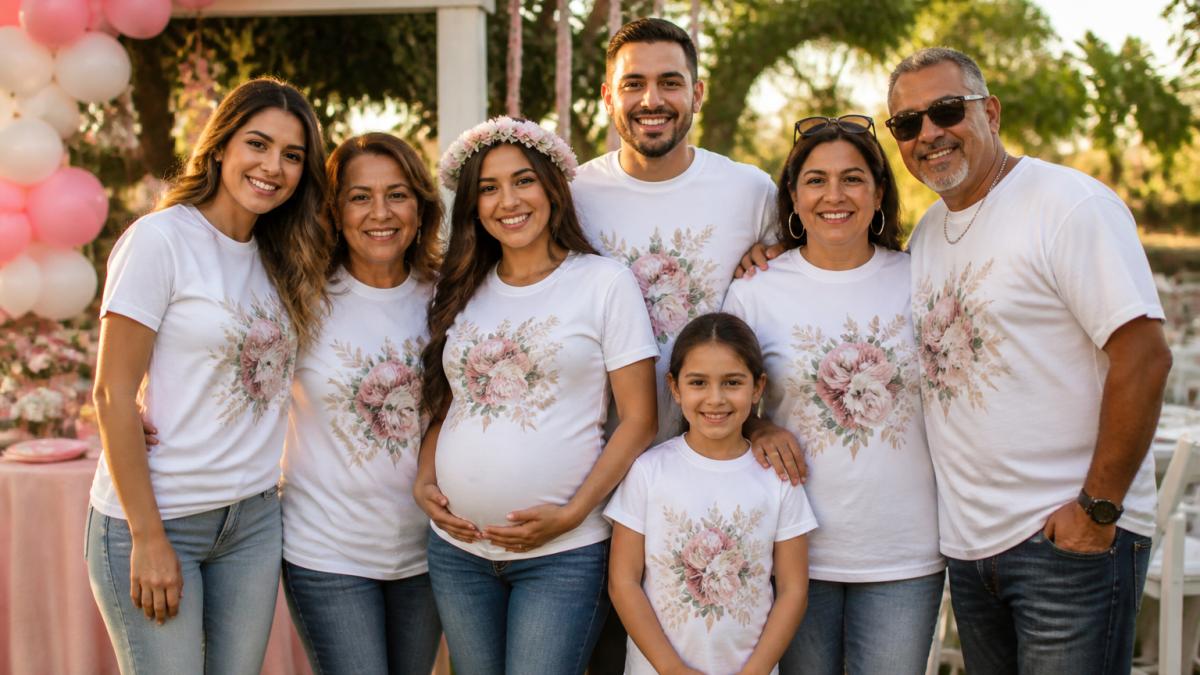
The right personalized apparel depends on the occasion, not just the design. Baby showers call for matching family sets, corporate events for embroidered polos, school trips for durable, easy-to-wash tees.
Matching Fabric Weight to the Occasion
- 3.8-4.3 oz: Lightweight performance and tri-blend tees. Best for warm-weather events, 5K runs, and giveaways where comfort beats durability.
- 4.5-5.5 oz: The everyday sweet spot. Ring-spun cotton here takes DTG and screen printing cleanly and feels soft enough for all-day wear. Most baby shower, family reunion, and school event tees live here.
- 6.0-6.5 oz: Heavyweight cotton. Best for workwear, construction crews, and anything washed weekly for years.
- 7 oz and up: Structured workwear and outerwear. Rarely right for one-time event apparel, it feels stiff and breaks in slowly.
Matching Print Method to the Occasion
| Occasion | Recommended Method | Why |
|---|---|---|
| Baby shower / gender reveal | DTG or heat transfer | Small runs, full-color art, no setup fees |
| Corporate event | Embroidery | Professional finish, survives years of wear |
| School trip / field day | Screen printing | Cheapest per unit at 50+, holds up to rough use |
| Family reunion | DTG | Names and dates change per person, no minimums |
| Trade show giveaway | Screen printing (1-2 colors) | Lowest cost at volume, fast turnaround |
| Sports team | Heat transfer or DTG | Names and numbers vary per player |
Care Instructions by Print Method
- DTG prints: Turn inside out, wash cold, tumble dry low or hang dry. Avoid fabric softener, which coats the ink and dulls color.
- Screen prints: Same routine, but wait at least 72 hours after receiving the garment before the first wash so the cured ink fully sets.
- Heat transfer: Wash inside out on cold and never iron directly over the transfer. Heat re-activates the adhesive and can lift the design.
- Embroidery: Machine washable on cold, but avoid bleach and high-heat drying, which shrink the backing and cause puckering.
A Note on Sustainability Certifications
If your occasion is tied to a brand, school, or nonprofit with sustainability commitments, ask which certifications the blanks carry. Two matter most:
- GOTS (Global Organic Textile Standard): Verifies organic fiber content and tracks the supply chain from harvest to finished garment.
- OEKO-TEX Standard 100: Verifies the finished garment is free from harmful substance levels, including inks and finishes.
These certifications appear on the garment's hang tag or come from the blank manufacturer. If a supplier can't name the certification, the "sustainable" claim is marketing, not verified.
We built our catalog around that idea. Our Floral Baby Shower Mom Tee and Floral Dad Baby Shower Shirt let both parents match at $19.99 each, printed on demand through Printful with 3-7 business day shipping. For siblings, the Sister in Bloom T-Shirt and Floral Brother Baby Shower Shirt make the big kids feel just as celebrated.
For the wider circle, the Floral Grandma Baby Shower Shirt, Grandpa In Bloom Social Club T-Shirt, and Godmother in Bloom T-Shirt round out a full matching set. Every piece is machine washable; turn it inside out to keep the print sharp.
Conclusion
Choosing among personalized apparel brands gets easier once you stop shopping on price alone. Match your needs to the brand's offerings, and you'll avoid common regrets.
If you'd rather skip the guesswork, Urban Echo Tees handles it for you. Every order is printed on demand, ships in 3-7 business days, and comes in designs built for baby showers, gender reveals, and family milestones. Get started with Urban Echo Tees and give the people you love a shirt they'll actually keep.
Frequently Asked Questions
What should I look for when choosing a personalized apparel brand?
Focus on four things: order quantity, turnaround time, and design proofing. Check if they offer small batch custom apparel without punishing minimums. Confirm they provide a digital proof before production so you can catch color or placement issues early. Finally, look for clear shipping timelines. Urban Echo Tees, for example, prints on demand via Printful and ships within 3-7 business days.
Are there personalized apparel brands that specialize in small-batch orders?
Yes. Print-on-demand services have made small batch custom apparel practical for orders of 10 shirts or fewer. Print-on-demand produces each item after you order it. Urban Echo Tees uses this model, so a parent ordering 8 class trip shirts pays the same per-unit price as someone ordering 50.
What is the difference between screen printing and embroidery for custom apparel?
Different printing methods have different characteristics. Screen printing presses ink through a mesh stencil onto fabric, often suited for bold designs and larger graphics. Embroidery stitches thread directly into the garment, giving a raised, textured look. Choose based on your design complexity, fabric type, and order size.
How do I ensure high-quality results when ordering personalized clothing?
Confirm the brand's care instructions. Urban Echo Tees recommends machine washing inside out to preserve the print. Following those steps reduces the chance of cracking, fading, or color shifts.
Can I order personalized apparel for one-time events like weddings or family trips?
Absolutely. One-time events are one of the fastest-growing uses for personalized apparel. Print-on-demand brands handle orders of any size, so you can get 6 matching shirts for a family trip or 20 for a wedding party without committing to bulk inventory. Urban Echo Tees offers occasion-specific designs starting at $19.99 per shirt, including baby shower, wedding, and holiday themes. Order at least three weeks ahead to account for production and shipping.