

How to Start a Shirt Business in 2026: Step-by-Step
Table of Contents
- How to Start a Shirt Business in 2026: The Step-by-Step Path
- Pick a Niche and Validate Demand Before You Spend a Dollar
- Build a Shirt Brand Identity and Positioning That Stands Out
- How to Start a T-Shirt Printing Business: Choose Your Printing Method
- How to Start a T-Shirt Business from Home: Workspace, Equipment, and Startup Costs
- Best E-Commerce Platforms for Custom Designs and Where to Sell
- How to Price T-Shirts for Profit: Margins, Break-Even, and Unit Economics
- Quality Control, Sizing, and Returns: The Details That Keep Customers
- Frequently Asked Questions
Last Updated: October 14, 2026
How to Start a Shirt Business in 2026: The Step-by-Step Path
The global T-shirt market hit $30.68 billion in 2026 and is projected to reach $44.81 billion by 2035, according to Printful's T-shirt industry statistics and trends. That growth is exactly why so many people want to know how to start a shirt business in 2026, and why so many of them get the order of operations wrong. This guide walks through niche validation, printing methods, startup costs, pricing math, and the quality-control details that protect your margins.
Pick a Niche and Validate Demand Before You Spend a Dollar
A profitable niche is a specific audience with a specific reason to buy, not a broad category like "funny shirts." Printful's 2026 growth strategies report recommends personalization and multi-channel selling, but neither works until you know who you're selling to (Printful's t-shirt business growth strategies). Pick one audience, one occasion, one style.
Market Research and Competitor Research That Actually Tells You Something
Search your niche on Etsy and Amazon. Note the top ten listings: their prices, their review counts, and their complaints. Review complaints are your product roadmap.
Demand Validation: Test the Idea Before You Print
Run a small pre-order or a single-sample post. If nobody engages with a free mockup, they won't pay for a printed shirt.
| Validation Test | Cost | What It Proves |
|---|---|---|
| Social poll on mockups | $0 | Whether the design concept lands |
| Pre-order with deposit | Payment processing only | Whether people will actually pay |
| One sample printed | Blank + print cost | Whether the print quality holds up |
Build a Shirt Brand Identity and Positioning That Stands Out
Brand identity is the combination of name, visual style, voice, and promise that tells a buyer what your shirts mean. Printful's 2026 strategy guidance flags sustainable and ethical sourcing as a positioning angle, though the research doesn't quantify consumer demand for it (Printful's t-shirt business growth strategies).
Urban Echo Tees offers a curated collection of custom T-shirts and sweatshirts designed to celebrate life's most meaningful moments, from personalized teacher apparel to unique gifts for family trips, weddings, and holidays.
How to Start a T-Shirt Printing Business: Choose Your Printing Method
Choosing a printing method is your biggest operational decision: it sets unit cost, minimum order, cash needs, and fulfillment speed. Most beginners pick a method from a video instead of matching it to their order volume.
The Five Realistic Methods, Compared
| Method | Typical Upfront Cost | Practical Minimum | Per-Unit Cost Pattern | Turnaround | Best For |
|---|---|---|---|---|---|
| Print-on-demand (POD) | $0 to a few hundred | 1 | Highest per unit; no inventory | Days, handled by the provider | Testing designs, no-cash launches |
| Direct-to-garment (DTG) | Roughly $5,000 to $30,000 for a printer | 1 | Moderate per unit; ink and pretreatment add up | Same day to a few days in-house | Small runs, photo-real or high-color art |
| Heat transfer / DTF | A few hundred to a few thousand | 1 | Low-to-moderate per unit; film and press time | Same day to a few days | Small runs, names and numbers, personalization |
| Screen printing | Screens and setup per design plus press | Often 12 to 24 per design per color | Lowest per unit at volume | Days to weeks | Bulk orders, events, proven winners |
| Custom cut-and-sew manufacturing | Highest; tooling, patterns, and deposits | Often hundreds to thousands per style | Lowest per unit at scale | Weeks to months | Established brands with a real following |
Cost ranges above are typical market ranges, not quotes. Get written quotes from at least two vendors per method before committing.
The Decision Framework: Match the Method to Your Volume and Cash
Work through these five questions in order. The first one you can't answer "yes" to tells you which method to use.
- Do you have proven demand? If no, use POD or heat transfer. You cannot afford screens or a printer before you know a design sells.
- Do you need more than roughly 24 units of one design? If yes, screen printing usually wins on per-unit cost. If no, DTG or heat transfer wins on flexibility.
- Do you need photo-real or unlimited-color artwork? If yes, DTG or DTF. Screen printing charges per color, so a six-color design gets expensive fast.
- Do you need personalization (names, numbers, dates)? If yes, DTF or DTG. Screen printing cannot economically print one-off variations.
- Can you fund inventory and wait weeks for delivery? If yes, custom manufacturing becomes viable. If no, stay with on-demand or in-house.
Quality, Sizing, and Turnaround Trade-Offs
- POD: You do not control the blank, the print placement, or the ship date. Quality varies by provider and by garment. Always order a sample from each provider you consider.
- DTG: Excellent for detailed art on 100% cotton. Results on dark garments and synthetic blends are less consistent, and wash durability depends on pretreatment.
- DTF / heat transfer: Strong color and stretch, works on many fabrics, and handles personalization well. Feel and durability depend on the film and press settings.
Do not compare methods on sticker price alone. A cheaper per-unit cost with a 500-unit minimum can tie up more cash than a higher per-unit cost with no minimum. Compare total cash at risk, not unit price.
Your fulfillment method should change as you grow. POD to validate, screen printing to scale, custom manufacturing to differentiate. Locking into one method on day one is the mistake.
How to Start a T-Shirt Business from Home: Workspace, Equipment, and Startup Costs
A basic home T-shirt printing setup costs roughly $500 to $5,000, according to Aesthetic BK's 2026 startup cost guide. That range covers a heat press, basic printing tools, blank shirts, and simple supplies.
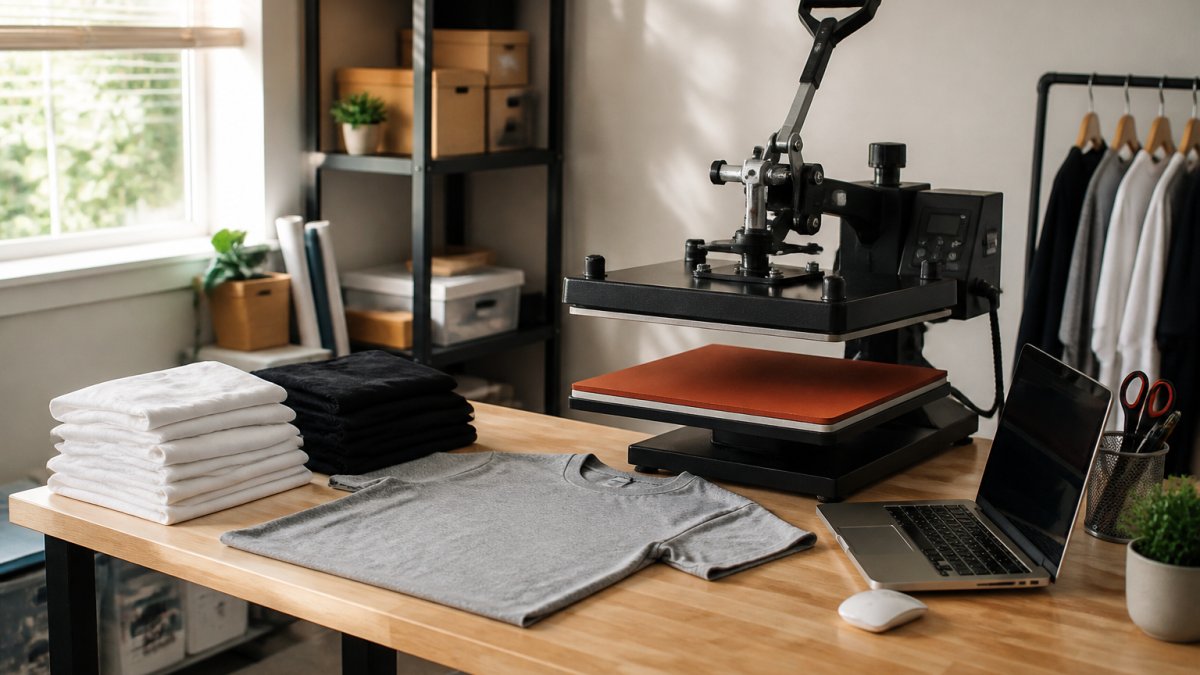
2026 Startup Budget: What You'll Actually Spend
Budget in three buckets: equipment, first inventory, and the costs beginners forget. That third bucket is where most plans break.
- Equipment: heat press, printer or screen setup, cutting tools
- Blanks and samples: enough to test sizing and print quality
- Forgotten costs: business registration, sales tax permits, packaging, shipping supplies, and platform fees
Your startup budget isn't complete until it includes packaging, shipping supplies, and platform fees. Those three line items quietly eat 10-15% of early revenue if you never planned for them.
Best E-Commerce Platforms for Custom Designs and Where to Sell
The best e-commerce platforms for custom designs are the ones that let customers upload artwork or pick variants without confusing them, and that handle tax and shipping without manual work.
Sell where your audience already is. A dedicated store gives you margin and customer data; marketplaces give you traffic. Most new shirt brands run both, the marketplace to find buyers, the store to keep them.
How to Price T-Shirts for Profit: Margins, Break-Even, and Unit Economics
Pricing a T-shirt for profit means covering landed cost, fees, and your time, then adding margin. Too many beginners price off a competitor's sticker and wonder why they never make money. Here's the math for two fulfillment models.
The Full Cost Stack (Most Beginners Miss Half of It)
Your landed cost per shirt is not the blank price. It is:
- Blank garment or POD base cost
- Print cost (per color, per location, or per print)
- Inbound shipping or freight, allocated per unit
Skip the last five lines and your "profit" is just revenue you haven't spent yet.
Worked Example: Print-on-Demand Unit Economics
Assume a POD base cost of $12.00, a retail price of $28.00, payment processing at roughly 2.9% plus $0.30, and no platform commission because you sell on your own store.
| Line | Amount |
|---|---|
| Retail price | $28.00 |
| POD base cost | -$12.00 |
| Payment processing (approx. 2.9% + $0.30) | -$1.11 |
| Packaging and supplies | -$0.50 |
| Returns/defect allowance (approx. 3%) | -$0.84 |
| Contribution margin per shirt | $13.55 |
At $13.55 per shirt, you need to sell about 74 shirts to cover $1,000 in fixed costs (store subscription, domain, design software, ads). That's your break-even.
Worked Example: Screen-Printed Unit Economics
Assume you print 50 shirts of one design, pay a setup fee per screen, and buy blanks in bulk.
| Line | Amount |
|---|---|
| Retail price | $28.00 |
| Blank cost (bulk) | -$4.50 |
| Print cost per shirt | -$3.00 |
| Setup fee, allocated across 50 units | -$1.00 |
| Payment processing (approx. 2.9% + $0.30) | -$1.11 |
| Packaging and supplies | -$0.50 |
| Returns/defect allowance (approx. 3%) | -$0.84 |
| Contribution margin per shirt | $17.05 |
Higher margin per shirt, but you spent roughly $425 upfront on inventory before selling a single unit. If only 20 shirts sell, your effective margin collapses because setup fees and unsold stock spread across fewer units.
Break-Even and Margin Targets
Break-even point = total fixed costs ÷ contribution margin per shirt.
- $1,000 fixed costs ÷ $13.55 = about 74 shirts (POD)
- $1,000 fixed costs ÷ $17.05 = about 59 shirts (screen printing, if all 50 sell)
New apparel sellers commonly see 40% to 60% gross margin on POD, higher on screen printing at volume. Below 30%, you likely have a pricing problem, a cost problem, or both.
Pricing Rules That Protect Your Margin
- Price from your cost stack up, not from a competitor down.
- Never discount below your contribution margin. A discount that erases margin just buys you a customer who will not return.
- Raise prices before you cut quality. Cheap blanks and cheap prints generate returns that cost more than the price increase would have.
Run the cost stack and the break-even math before you set a price, not after. If the numbers do not work at your target price, change the method, the blank, or the price. Do not hope volume fixes a broken unit economic.
Quality Control, Sizing, and Returns: The Details That Keep Customers
Quality control means checking print placement, color accuracy, and fabric weight before an order ships, it separates a brand with repeat customers from one with refund requests.
Returns happen. What matters is your policy and speed: a clear size chart and accurate mockups prevent most, and a fast, no-argument exchange keeps the customer you'd otherwise lose.
Starting a shirt business in 2026 comes down to validating demand before you spend, choosing a fulfillment method that matches your volume, and pricing with real unit economics instead of guesswork.
Frequently Asked Questions
How much does it cost to start a T-shirt business?
A basic home setup for a shirt business runs about $500 to $5,000, according to Aesthetic BK's 2026 guide. That range covers a heat press, basic printing tools, blank shirts, and simple supplies. You can start lower with print-on-demand, where you pay per order instead of buying equipment upfront. Your actual startup costs depend on your printing method, how much inventory you hold, and whether you build your own online store or sell through a marketplace.
Should I use print-on-demand or print shirts myself?
Print-on-demand lets you start a T-shirt business without building a full in-house production setup, as Printify notes in its 2026 guide. It works well when you want to test designs without holding inventory. Printing yourself gives you more control over fabric weight, print quality, and turnaround, but requires equipment and space. A common path is to validate designs with print-on-demand first, then move to in-house printing once a design consistently sells.
How do I choose a niche for a T-shirt business?
Start with a specific audience you understand, not a generic apparel theme. A niche like teacher appreciation gifts, family reunion shirts, or wedding party apparel gives you a clear target audience and makes marketing easier. Before investing in designs, run market research and competitor research to see what already sells in that space. Validate demand with a small test batch or a pre-order before you commit to inventory.
Is a shirt-making business profitable?
Profitability depends on your pricing, production costs, and how well your designs match demand. The global T-shirt market is valued at $30.68 billion in 2026 and projected to reach $44.81 billion by 2035, at a 4.3% compound annual growth rate, per Printful. The custom segment is growing even faster, with Printify reporting more than 11.5% annual growth. Your margin comes down to unit economics: know your cost per shirt and your break-even point before you scale.
What equipment do I need to start a T-shirt printing business?
For a home screen printing setup, you need a heat press or screen printing press, screens, ink, squeegees, and blank shirts. For heat transfer vinyl, a cutting machine and heat press cover most jobs. Print-on-demand requires no equipment, just a supplier and an online store. Your choice depends on your printing method, order volume, and budget. Start with the minimum equipment for your first 20 to 30 orders, then reinvest as sales grow.
Where can I sell custom T-shirts online?
You can sell through your own online store, marketplaces like Etsy or Amazon, or social platforms. The best e-commerce platforms for custom designs include options that handle product listings, mockups, and shipping integrations. Selling on multiple sales channels helps you reach different audiences, which Printful lists as a growth strategy for 2026. Pick one primary channel for launch, then add a second once your first channel produces consistent sales.
How do I price T-shirts for a profit?
Start with your total cost per shirt: blank garment, printing, packaging, and shipping. Add your target profit margin, then check what similar shirts sell for in your niche. A simple formula is cost times two for a basic retail margin, but custom and niche shirts often support higher prices. Track your break-even point so you know how many shirts you need to sell before you cover fixed costs. Review pricing quarterly as supplier costs change.