

Custom Sweatshirt Printing for Teams: A 2026 Guide
Table of Contents
- Why Custom Sweatshirt Printing Works for Team Building
- Screen Printing vs. Embroidery for Team Apparel: Which Method Lasts
- Choosing the Best Sweatshirt Brands for Custom Printing
- Bulk Custom Hoodie Pricing: What to Expect
- Turnaround Time for Custom Team Orders: Planning Your Timeline
- Designing Your Custom Team Sweatshirts: A Practical Approach
- Small Orders and Minimum Requirements
- Sustainability and Eco-Friendly Fabric Options
Last Updated: August 9, 2026
Why Custom Sweatshirt Printing Works for Team Building
Custom sweatshirt printing for teams creates a tangible symbol of belonging that reinforces group identity. When your team wears matching apparel with a shared design, people feel part of something larger than themselves. A custom sweatshirt with your team's logo or inside joke gets worn repeatedly, unlike generic hoodies that sit in closets.
Beyond sentiment, custom apparel eliminates guesswork in gift-giving or uniforms. Everyone gets exactly what you ordered, in the right size, with consistent branding. The real value emerges when you combine quality materials with thoughtful design. A poorly printed sweatshirt cracks and fades after a few washes. A well-executed custom sweatshirt becomes a staple piece that extends the lifespan of your team's branding and the emotional resonance of the event itself.
Screen Printing vs. Embroidery for Team Apparel: Which Method Lasts
The choice between screen printing and embroidery determines how your custom sweatshirt printing for teams will look, feel, and age over time.
Screen Printing: Speed, Vibrancy, and Cost-Effectiveness
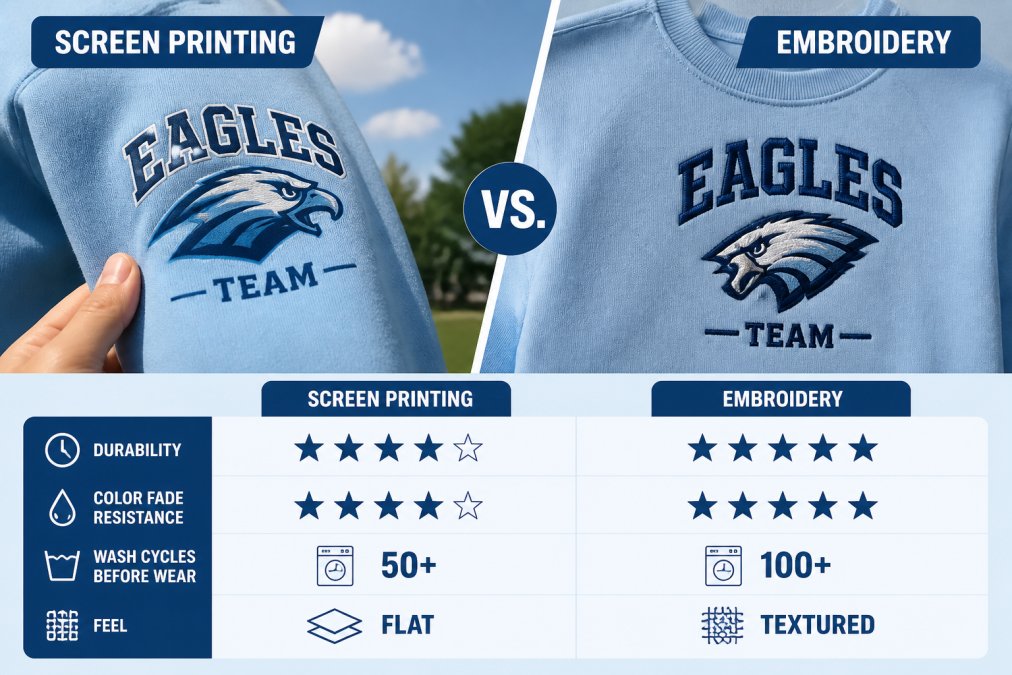
Screen printing applies ink directly to fabric through a mesh screen, creating a flat, vibrant finish that excels at reproducing detailed artwork, gradients, and photographic images. Setup requires creating screens for each color layer, which adds upfront costs but becomes economical at volume. A single-color design on 50 sweatshirts costs significantly less per unit than embroidery.
High-quality screen printing withstands 50-75 washes before noticeable fading occurs, though the print may crack if the garment is stretched excessively or tumble-dried on high heat. Screen printing works best for designs with solid colors, bold graphics, or detailed artwork that would be prohibitively expensive to embroider. Most facilities complete screen-printed orders within 5-10 business days.
Embroidery: Durability and Professional Polish
Embroidery stitches thread directly into the fabric, creating a three-dimensional texture and inherent durability. A well-embroidered logo can survive 100+ washes with minimal degradation because the design is physically integrated into the garment, not sitting on top.
The trade-off is complexity. Embroidery works beautifully for logos, text, and simple geometric designs. Photographic images or gradients don't translate well to thread, and small details become illegible when stitched. Embroidery carries a professional aesthetic that signals quality and craftsmanship, making it ideal for corporate events or formal team apparel.
Production timelines for embroidery typically run 7-14 business days because each garment requires individual stitching. Minimum order quantities are often higher than screen printing, though small-run embroidery shops are becoming more common.
Choosing the Best Sweatshirt Brands for Custom Printing
Not all sweatshirts accept custom printing equally. Fabric weight, fiber composition, and surface finish affect how your design looks and how long it lasts.
Fabric Weight and Breathability Matter
Sweatshirt weight is measured in ounces per square yard (oz/yd²). The sweet spot for custom sweatshirt printing for teams is 9-10 oz, heavy enough to feel quality without being restrictive. This weight provides adequate density for screen printing without excessive ink saturation and holds embroidery thread securely without puckering.
Fabric composition matters too. 100% cotton sweatshirts breathe well but shrink unpredictably. Cotton-poly blends (80/20 or 70/30) reduce shrinkage, resist wrinkles, and improve durability while maintaining breathability. For teams that will wear apparel in warm environments or during physical activity, a cotton-poly blend prevents the garment from feeling heavy or uncomfortable.
Pullover vs. Zip-Up: What Your Team Needs
Pullover hoodies offer simplicity and a classic look with a clean canvas for design placement. Zip-ups add versatility but create visual interruption from the zipper. For custom sweatshirt printing for teams, pullovers are generally better if you're prioritizing visual impact and design continuity. Zip-ups work better when the sweatshirt functions as an outer layer that team members will wear in varied conditions.
Bulk Custom Hoodie Pricing: What to Expect
Bulk pricing for custom sweatshirt printing for teams depends on quantity, printing method, design complexity, and rush timelines.
How Order Quantity Affects Your Cost
Printing costs drop significantly as order quantity increases because setup expenses are distributed across more units. A 12-shirt order costs substantially more per unit than a 100-shirt order. Small-run printing services have disrupted this model, allowing teams to order as few as 6-10 custom sweatshirts without prohibitive per-unit costs.
The cost per unit decreases incrementally at certain thresholds. Ordering 25 units costs less per shirt than ordering 12. This tiered pricing structure means you should order slightly more than your minimum need if the per-unit savings justify the extra inventory.
Additional Charges: Design Proofing and Rush Orders
Design proofing, where the printer creates a mockup showing exactly how your custom sweatshirt printing for teams will look, is sometimes free and sometimes $25-75 depending on complexity and revisions. This step is essential because it's your last chance to catch color-match issues before production.
Rush orders incur expedited fees. Standard production for screen printing runs 5-10 business days. Requesting completion in 2-3 days typically adds 25-50% to the order cost. Setup fees for screen printing range depending on the number of colors. A single-color design might have minimal setup cost; a four-color design could add $50-150. Embroidery digitization typically costs $25-75 per design.
Turnaround Time for Custom Team Orders: Planning Your Timeline
Understanding production windows prevents the panic of a rushed deadline.
Standard vs. Rush Production
Standard production for screen printing typically runs 7-10 business days from approval of your design proof. Embroidery production runs longer, typically 10-14 business days because each garment is individually stitched.
Shipping adds 2-5 business days depending on your location and chosen method. A team ordering custom sweatshirts for an event three weeks away needs to account for production time plus shipping. Submitting clean, finalized artwork accelerates the entire timeline.
Many facilities offer rush production for an additional fee, compressing timelines to 2-3 business days for screen printing. This is invaluable when you've underestimated how long the process takes, but it comes at 30-50% cost premium.
Designing Your Custom Team Sweatshirts: A Practical Approach
The design phase determines whether your final product looks professional or amateur.
Vector Artwork and File Format Requirements
Printers require vector artwork, scalable design files created in Adobe Illustrator, CorelDRAW, or similar software. Vector files use mathematical paths to define shapes and lines, so they scale infinitely without losing quality. Raster files (JPEGs, PNGs) are pixel-based and become blurry when enlarged.
If you don't have vector artwork, hire a designer to create it (typically $50-300 depending on complexity) or use your printer's design services. Most printers request files in Adobe Illustrator (.ai), PDF, or EPS format at minimum 300 DPI resolution. Submit files with all fonts converted to outlines to prevent font substitution issues.
Custom Logo Placement and Color Matching
Chest placement is standard and most economical. Back placement costs the same but offers larger canvas space. Sleeve placement adds complexity because the print surface is curved.
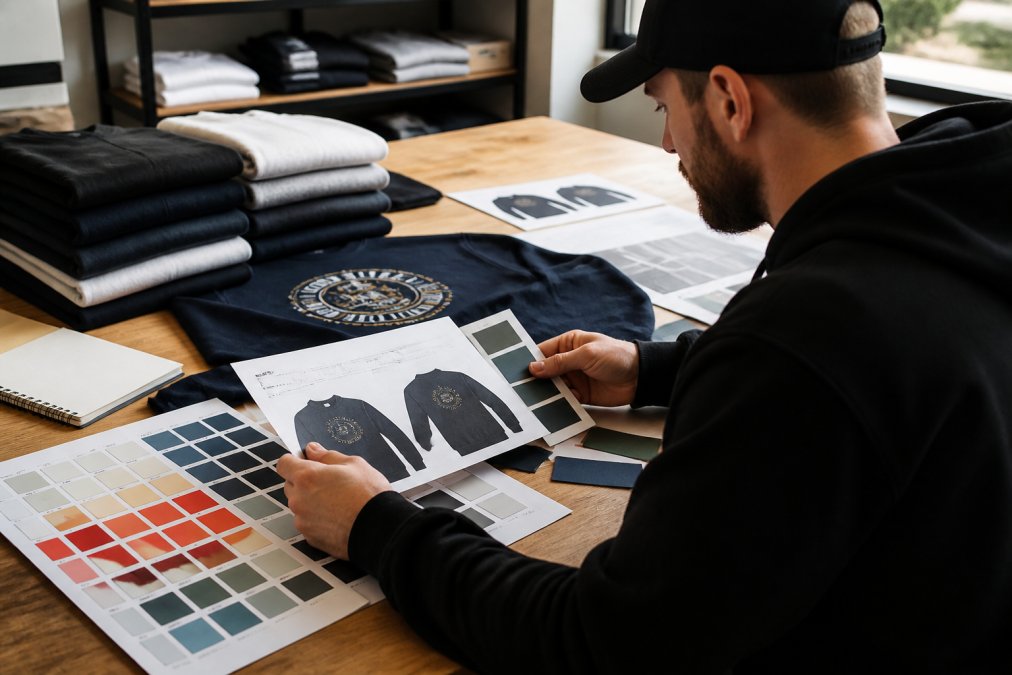
Color matching is where most teams encounter frustration. Your screen shows colors one way; the sweatshirt print looks different because fabric absorbs and reflects light differently than screens. The solution is requesting a physical swatch or sample before full production.
Pantone matching, specifying colors using Pantone Matching System (PMS) numbers, ensures consistency across production runs. If you order more sweatshirts later, Pantone numbers guarantee the color matches your original batch.
The Design Proofing Process
The proof is your protection. This mockup shows exactly how your custom sweatshirt printing for teams will appear: colors, placement, size, everything. Never approve production without reviewing the proof.
Request proofs in multiple formats if possible. Digital proofs show placement and general appearance. Physical samples show actual color and print texture. Review proofs carefully for legible text, accurate colors, balanced placement, and proper margins. Revision rounds are normal; most printers include 1-2 free revision rounds.
Small Orders and Minimum Requirements
Traditional bulk printers require 50+ units, which doesn't work for small teams or classroom orders. Small-run printing typically works through digital printing methods (direct-to-garment) rather than traditional screen printing. These methods eliminate setup fees and screen costs, making small orders economically viable. Minimum orders typically start at 6-12 units depending on printing method.
Sustainability and Eco-Friendly Fabric Options
More teams now prioritize environmental impact when choosing custom sweatshirt printing for teams. Organic cotton sweatshirts eliminate synthetic pesticides and reduce water consumption compared to conventional cotton, costing 15-30% more. Recycled polyester blends use post-consumer plastic bottles, diverting waste from landfills.
Water-based inks for screen printing reduce chemical runoff compared to plastisol inks and require lower curing temperatures. Eco-friendly packaging using recycled cardboard and compostable mailers reduces waste. This alignment strengthens the meaning of the apparel beyond just visual branding.
Ordering custom sweatshirt printing for teams requires navigating printing methods, fabric specifications, design requirements, and timelines. Each decision serves a purpose: screen printing or embroidery depends on your design and durability needs; bulk quantity or small order depends on your team size and budget; rush timeline or standard production depends on your event date.
Urban Echo Tees simplifies this complexity by handling the technical details while you focus on celebrating your team. Start with a conversation about your specific needs, get a design proof to verify quality, and proceed knowing your order will arrive on time and exceed expectations.
Frequently Asked Questions
What's the fastest turnaround time for custom team sweatshirts?
Turnaround time for custom team orders typically ranges from standard production (7-10 business days) to rush options (3-5 business days), depending on the printing method and order complexity. Screen printing generally offers faster turnaround than embroidery. Factors like design approval time, fabric availability, and shipping method affect your final delivery date. Rush shipping adds cost but can get orders to you within days once production finishes. Always confirm timelines with your vendor before placing an order to ensure your event deadline is realistic.
Can I order custom sweatshirts for a small team without hitting a high minimum?
Yes, many custom apparel providers now accept small orders starting at 5-10 pieces, though pricing per unit will be higher than bulk orders. Urban Echo Tees specializes in smaller team orders, recognizing that not every group needs 50+ sweatshirts. The per-unit cost decreases significantly as order quantity increases, but small orders remain viable for teacher appreciation events, family trips, or small work teams. Expect to pay a modest setup fee for design proofing and artwork preparation, which gets spread across fewer items than bulk orders.
Which printing method lasts longer on custom team sweatshirts?
Embroidery offers superior durability and longevity, with thread remaining intact through hundreds of washes without cracking or fading. Screen printing provides excellent wash fastness when done correctly, typically lasting 50-100+ washes before noticeable wear, but eventually shows cracking or fading. Embroidery suits team apparel meant to last years, while screen printing works well for event-specific orders or shorter-term wear. The choice depends on your budget, timeline, and how long the sweatshirts need to hold up.
What file format do I need for custom team logo printing?
Vector artwork in formats like AI, EPS, or PDF works best for screen printing and embroidery, as these scale cleanly without quality loss. If you don't have vector files, high-resolution raster images (300 DPI minimum) in PNG or JPG format are acceptable for screen printing. Many providers offer design services or will convert your logo to vector format for a small fee. Always check with your vendor's specific file requirements before submitting artwork, as different printing methods have slightly different technical needs.
This article was written using GrandRanker