

Custom Sweatshirt Design Ideas vs Pre-Made Prints
Table of Contents
- Custom Sweatshirt Design Ideas vs Pre-Made Prints: The Quick Comparison
- Cost of Custom vs Retail Sweatshirts: What You Actually Pay
- Best Printing Methods for Hoodies and Sweatshirts
- Design Ideas That Work: Placement, Fabric, and Retail-Ready Looks
- Personalized Apparel for Family Trips and Group Events
- Pre-Made Prints vs Custom Design: Durability and Sustainability
- Which Option Fits Your Project?
- Frequently Asked Questions
Last Updated: October 2, 2026
Custom Sweatshirt Design Ideas vs Pre-Made Prints: The Quick Comparison
The custom apparel market is booming. According to Printify's 2026 market projection, the hoodies and sweatshirts sector is expected to reach $442.64 billion by 2034.
Custom sweatshirt design is the process of creating original artwork, selecting garment styles, and choosing decoration methods like screen printing or embroidery to produce apparel tailored to a specific group or occasion.
The quick verdict: custom wins for groups, gifts, and anything with a logo or inside joke. Pre-made wins when you need one shirt fast and don't care about uniqueness.
| Factor | Custom Design | Pre-Made Prints |
|---|---|---|
| Minimum order | None | |
| Cost per unit | $15-$30 retail | |
| Uniqueness | Fully original | Mass-produced |
| Best for | Groups, gifts, events | Solo, instant need |
| Lead time | 1-3 weeks | Same day |
Cost of Custom vs Retail Sweatshirts: What You Actually Pay
The sticker price is the wrong number to compare. A custom sweatshirt and a pre-made printed sweatshirt are built on different cost structures, and the gap swings hard depending on order quantity, artwork, and labor.
Pre-made print stack (buying a finished garment):
- Blank garment cost (already baked into retail price)
- Design licensing or royalty fee, if you're buying a stock design from a marketplace
- Retail markup (typically 2x-2.5x the wholesale cost)
- Shipping, and often a per-item fee if the seller prints on demand
Custom design stack (commissioning or DIY):
- Blank sweatshirt
- One-time artwork or digitizing fee
- Screen setup or embroidery digitizing fee (per color, per location)
- Per-piece print or stitch run charge
- Your own labor, if you press or print in-house
The line that trips most buyers is the design fee. A pre-made print hides that cost inside the retail price; a custom order surfaces it separately, making custom look pricier at quantity one even when it isn't at quantity twenty.
The Pre-Made Design Fee Nobody Talks About
When you buy a pre-made printed sweatshirt, you're usually paying a licensing or royalty component for someone else's artwork, folded into a base price plus seller margin on print-on-demand marketplaces, or inside the wholesale-to-retail spread on retail stock designs.
With a custom design, you pay the artwork cost once. After that, every additional piece carries only the blank plus the decoration run charge. That's why custom wins at volume and loses at quantity one.
Breaking Down the Bulk Order Math
A common pattern for a 20-piece order with a one-color front print:
- Blank sweatshirt: $12-$18 each
- Artwork or vector cleanup (one-time): $0-$75, depending on whether your file is print-ready
- Screen setup (one-time): $25-$50 per color
- Printing: $3-$6 per piece
- Total per unit at 20 pieces: roughly $18-$26
Compare that to 20 pre-made printed sweatshirts at a $30 retail average: $600, with no design control and no ability to reorder the same print later.
Two-color prints can cut production costs by roughly 30% versus a comparable multi-color setup, according to Underground Printing's cost analysis, because setup fees get spread across more pieces and the press run is more efficient.
The DIY Labor Trade-Off
If you press transfers at home, you skip setup fees but absorb the labor. A heat press runs a few hundred dollars, and a single transfer takes a few minutes of press time plus cooling and peel.
The honest rule of thumb: DIY wins below roughly 10-12 pieces or when the design changes every time. Outsourcing wins above that, or whenever your time is worth more than the per-piece savings.
When Pre-Made Actually Costs Less
Pre-made wins on total cost in three situations:
- You need one piece. No setup fee to amortize, no artwork cost, no minimum.
- You want a design you don't own. If you only need the look once, licensing someone else's print is cheaper than commissioning your own.
- You need it today. Rush custom orders carry expedite fees that erase the per-unit advantage.
For everything else, run the two stacks against your actual quantity before assuming retail is cheaper. The crossover point is usually somewhere between 8 and 12 pieces.
Best Printing Methods for Hoodies and Sweatshirts
Screen printing is the most cost-effective method for group orders of 12 or more pieces, according to Custom Ink's printing guide. For smaller runs or detailed logos, embroidery and heat press transfers take over.
The three main options:
- Screen printing: Often used for bold graphics and solid colors.
- Embroidery: Often used for logos and a premium feel.
- Heat press transfers: Often used for small batches and full-color photos.
Screen Printing vs Embroidery: Which Lasts Longer?
Embroidery is known for its durability. The trade-off is cost and detail, embroidery can struggle with fine gradients and tiny text, while screen printing can handle complex multi-color artwork.
Design Ideas That Work: Placement, Fabric, and Retail-Ready Looks
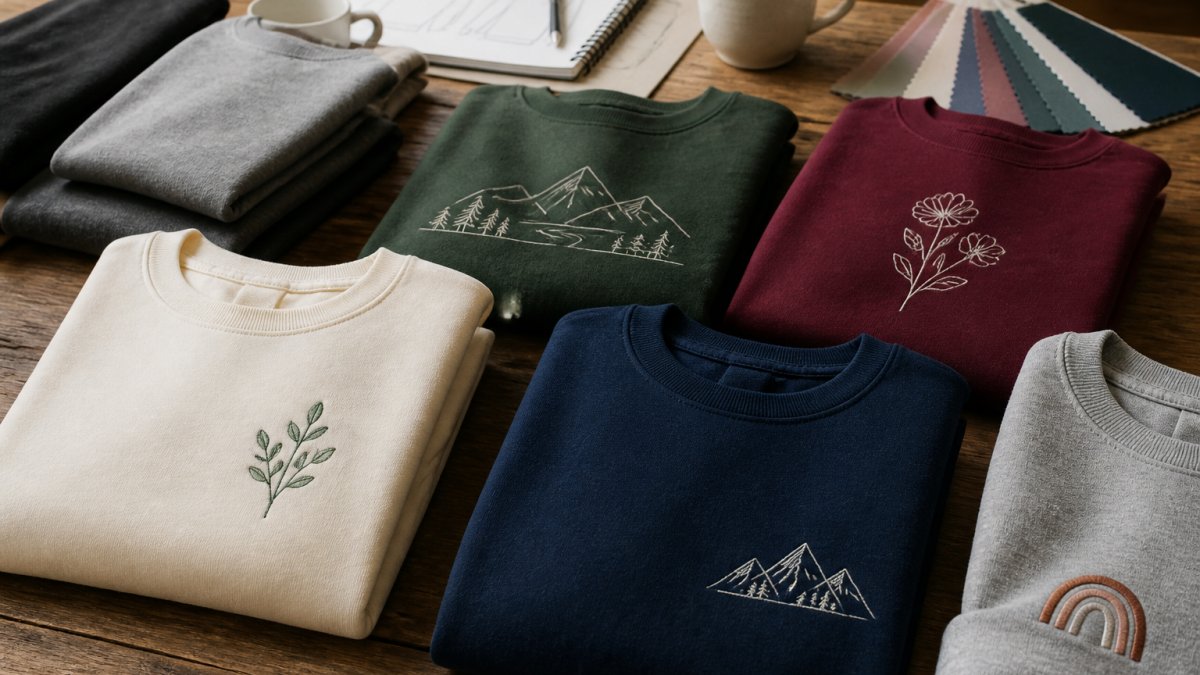
The strongest custom sweatshirt design ideas in 2026 lean on three elements: oversized fits, sustainable fabrics, and minimalist branding, according to Monday Merch's design trend report. Buyers want garments that look like they came off a boutique rack, not a promotional catalog.
Start with placement. A left-chest logo reads professional. A full back print reads statement. Sleeve graphics add a subtle detail that most people miss until they see it up close.
Fabric weight matters just as much. Heavier fleece holds its shape and prints better. Lighter blends feel softer but show wear faster.
Retail-ready looks to try:
Five Years Rooted 5th Anniversary Sweatshirt →
- Oversized back prints with small front logos
- Embroidered chest crests on heavyweight fleece
- Vintage wash finishes for a worn-in feel
- Minimalist single-color designs
Personalized Apparel for Family Trips and Group Events
Personalized apparel for family trips turns a matching outfit into a souvenir people actually keep. Reunion shirts, vacation hoodies, and team sweatshirts work because they mark a shared moment, not just a logo. Group orders usually fall into a few buckets:
- Family reunions and vacations
- Teacher appreciation and school events
- Weddings and bachelor or bachelorette parties
- Team sports and club events
For these projects, the design does the emotional work. A custom sweatshirt celebrating a milestone beats a generic souvenir every time. Urban Echo Tees builds designs around exactly these moments, from anniversary keepsakes to teacher gifts.
Pre-Made Prints vs Custom Design: Durability and Sustainability
Most comparisons stop at "custom lasts longer." The durability of a design often comes down to how the decoration bonds to the fabric, how the ink or thread is cured, and what the garment is made of.
Why Prints Crack, Fade, and Peel
A printed design fails in one of three ways:
- Cracking happens when the ink film is thicker than the fabric can flex with. The print can't stretch as far as the garment, so it fractures along the fold lines. This is the classic failure mode of cheap plastisol prints on thin blends.
- Fading comes from pigment breakdown under UV and repeated detergent exposure. Lower-quality inks and under-cured prints fade faster because the pigment never fully set into the fabric.
- Peeling is a bond failure. Heat-transfer vinyl and low-quality transfers delaminate when the adhesive layer wasn't pressed at the right temperature, pressure, and dwell time.
Custom screen printing and embroidery avoid most of these because the decoration is fused into the fabric at a controlled cure temperature or stitched through it. Pre-made retail prints vary wildly, since the cheapest mass-production runs optimize for speed, not cure accuracy.
The Wash-Test Reality
A properly cured screen print on midweight cotton or cotton-poly fleece can survive many wash cycles without visible cracking, provided you wash inside out in cold water and avoid high-heat drying.
Heat-transfer prints can vary in durability: a well-pressed transfer on compatible fabric can hold up well, while a poorly pressed one on a slick synthetic blend may start lifting within a handful of washes.
Durability Checklist Before You Buy
- Confirm the decoration method
- [ ]
- Check fabric weight; heavier fleece holds shape and prints better over time
- [ ]
- Verify ink type if you care about hand-feel and long-term flexibility
Sustainability: Where Custom and Pre-Made Actually Diverge
The sustainability story is more nuanced than "custom is greener." Three factors drive the real footprint:
Overproduction. Pre-made retail forecasts demand and produces inventory in advance; unsold stock becomes markdowns, liquidation, or waste. Custom and print-on-demand produce only what's ordered, eliminating dead inventory entirely, custom's biggest environmental advantage.
Ink chemistry. Not all custom printing is clean. If sustainability matters, consider asking about ink systems.
Fiber content. Organic cotton and recycled polyester blanks carry a lower footprint than conventional cotton and virgin synthetic blends, but cost more per unit.
A common pattern is that buyers focus on the print method and ignore the blank. Switching to an organic or recycled blank can impact sustainability.
The Honest Trade-Off
Custom can offer durability when the decoration is properly cured and matched to the fabric, and sustainability when overproduction is avoided and lower-impact blanks and inks are chosen. Pre-made may be suitable when volume is too low to justify setup or when a design you don't own is desired.
If you're ordering for a group, consider asking about ink systems and blank options. The answers can provide insight into longevity and footprint.
Which Option Fits Your Project?
Pre-made prints win when you need one item today and don't care about customization. Custom design wins for everything else: groups, gifts, events, and anything needing a personal touch. Three questions decide it:
- How many do you need? Under 5, pre-made is simpler. Over 10, custom usually costs less per unit.
- Does it need to be unique? If yes, custom is the only answer.
- What's your timeline? Custom takes 1-3 weeks. Pre-made ships same day.
For milestone moments, custom apparel is the clear pick. Urban Echo Tees offers custom T-shirts and sweatshirts built for birthdays, weddings, school events, family trips, and holidays, with personalized options that turn a plain garment into a keepsake.
Choosing between custom and pre-made comes down to whether the garment needs to mean something. For one-off purchases, retail works fine. For events, gifts, and groups, custom apparel creates something people keep.
Frequently Asked Questions
What are some creative custom sweatshirt design ideas?
Top design ideas for 2026 include oversized back prints, embroidered logos, vintage wash finishes, and minimalist branding. You can also try sleeve graphics, all-over prints, or themed artwork for specific events. Urban Echo Tees offers designs like the Five Years Rooted 5th Anniversary Sweatshirt, which uses detailed vintage-style artwork with woodgrain elements and heartfelt messages. For group orders, consider a simple logo placement on the chest or a bold statement across the back.
How much should a custom sweatshirt cost?
Custom sweatshirt pricing depends on the printing method and order size. Screen printing can be cost-effective for orders of 12 or more pieces. For small orders or single gifts, expect to pay more per piece. Urban Echo Tees offers custom sweatshirts starting at $32.99, which includes the design and printing.
Is it cheaper to buy pre-made prints or design your own?
Pre-made prints are cheaper for one-off purchases because there is no design or setup cost. Custom design becomes more cost-effective for groups of 12 or more, where screen printing reduces the per-unit price. If you need personalized apparel for family trips or events, custom design offers better value and uniqueness. For individual gifts, pre-made options may be more budget-friendly, but custom designs add a personal touch that pre-made cannot match.
How do I ensure high quality when ordering custom apparel?
Check the fabric weight and garment quality before ordering. Ask about the printing method. Request a sample or digital proof to verify colors and placement. Urban Echo Tees uses pre-shrunk, classic fit sweatshirts made with air-jet spun yarn for a soft feel and double-needle stitching for durability.
What are the benefits of personalized apparel for special events?
Personalized apparel creates a sense of unity and commemorates the occasion. For family trips, matching sweatshirts make group photos memorable and help identify your group in crowds. For events like teacher appreciation or anniversaries, custom designs show thoughtfulness. Personalized items also make great gifts because they reflect the recipient's interests or milestone. Urban Echo Tees specializes in occasion-specific designs, from anniversaries to family trips, ensuring your event stands out.