

Cheapest Way to Print Custom T-Shirts in Bulk
Table of Contents
- Understanding Bulk T-Shirt Printing Costs
- Cheap T-Shirt Printing Methods That Actually Work
- Screen Printing Bulk Shirts: The Cost Advantage
- Bulk T-Shirt Printing Cost: Finding Your Break-Even Point
- Hidden Costs and How to Avoid Them
- Getting Competitive Quotes: A Step-by-Step Process
- Quality Checks and Sample Orders
- Frequently Asked Questions
Last Updated: October 6, 2026
Understanding Bulk T-Shirt Printing Costs
The cheapest way to print custom t-shirts in bulk depends on your order size, design complexity, and timeline. There's no single answer that works for every situation, but understanding how different printing methods scale will help you find the most cost-effective option.
When you're ordering in volume, per-shirt costs drop dramatically as quantities increase. A single custom shirt might cost significantly more than one shirt in a 500-unit order. This is where bulk pricing really matters. The key is matching your printing method to your order size, because what's cheapest at 50 shirts isn't necessarily cheapest at 5,000 shirts.
Most businesses overlook a critical factor: setup fees and minimum orders can wipe out savings on small runs. A method with lower per-shirt pricing might carry a $200 setup fee that makes sense only if you're ordering hundreds of units. Understanding these hidden costs upfront prevents expensive mistakes.
Cheap T-Shirt Printing Methods That Actually Work
Three main printing methods dominate bulk orders. Each has a break-even point where it becomes the most economical choice.
Screen Printing for Bulk Orders
Screen printing is often presented as the most cost-effective option for large runs, particularly when designs use solid colors. This method involves creating a mesh screen for each color in your design, then pushing ink through the screen onto each shirt.
The advantage is straightforward: once you've paid for screen setup, the per-shirt cost drops significantly with each additional unit. For solid-color designs on large quantities, screen printing typically delivers the lowest per-shirt price. Many print shops advertise this as their budget-friendly option for companies ordering 100+ shirts.
The catch is that screen printing becomes expensive for small orders. Setup costs, creating the screens, don't change whether you're printing 25 shirts or 250 shirts. That fixed cost matters most when spread across a small quantity.
Screen printing also works best with simpler designs. Multi-color designs require multiple screens, which increases setup complexity and cost. Detailed artwork or photorealistic images are difficult to reproduce accurately with this method.
Direct-to-Garment Printing
Direct-to-garment (DTG) printing applies ink directly to the shirt using specialized inkjet technology. There's no screen setup, no minimum order requirement, and no color limitations. This method handles photorealistic images, gradients, and complex multi-color designs without additional cost.
DTG's strength is flexibility. You can order 10 shirts or 1,000 with the same per-shirt pricing structure. There's no penalty for small orders. This makes DTG ideal for custom one-offs, small team orders, or when you're testing a design before committing to a larger run.
The trade-off is per-shirt cost. DTG pricing per unit is typically higher than screen printing for large quantities because there's no setup-cost advantage to offset. The ink costs are consistent whether you're printing your first shirt or your hundredth.
DTG also has durability considerations. The ink sits on top of the fabric rather than bonding into it, so the print can crack or fade with heavy washing over time. For gifts or occasional-wear items, this is rarely a problem. For uniforms or workwear that gets washed frequently, it matters.
Print-on-Demand Services
Print-on-demand (POD) platforms like Printful's bulk T-shirt pricing guide handle everything: design hosting, inventory management, printing, and shipping. You upload your design, set your price, and the platform prints and ships orders as they come in.
POD services eliminate upfront inventory risk. You don't pay for shirts until someone orders them. This is valuable if you're testing whether a design will actually sell before investing in 500 units.
The cheapest way to print custom t-shirts in bulk using POD is typically through volume discounts on finished orders rather than ordering a fixed quantity upfront. Some POD platforms offer bulk discounts when you place a single large order at once, though these discounts are usually smaller than what you'd get from a dedicated print shop.
POD works well for small orders and ongoing sales. It doesn't work well if you need the absolute lowest per-shirt cost on a massive run, dedicated print shops will beat POD pricing on bulk orders of 500+ units.
Screen Printing Bulk Shirts: The Cost Advantage
Screen printing becomes the cost leader once your order reaches a certain volume threshold. Understanding where that threshold sits for your specific project prevents overpaying.
The economics work like this: screen setup costs a fixed amount regardless of quantity. That cost gets divided across every shirt printed. At 50 shirts, that setup fee adds significantly to each shirt's cost. At 500 shirts, it's barely noticeable.
This is why vendors emphasize screen printing for bulk orders. Independent screen-printers typically charge setup fees separately from per-shirt costs, making the math transparent. As your order grows, the per-shirt price drops while the setup cost stays the same.
The best candidates for screen printing are orders with:
- Solid-color or simple designs (fewer screens needed)
- Large order quantities (100+ units)
- Standard shirt sizes and colors
- Reasonable timelines (rush orders cost more)
Avoid screen printing for:
- Multi-color photorealistic designs
- Small orders (under 50 units)
- Designs requiring custom color matching
- Rush deadlines
Bulk T-Shirt Printing Cost: Finding Your Break-Even Point
The break-even point is where one printing method becomes cheaper than another. This point shifts based on your design complexity, order quantity, and timeline.
For a simple one-color design:
- Screen printing becomes cheaper than DTG around 75-100 units
- Below that, DTG's lack of setup fees makes it more affordable
- Above that, screen printing's per-shirt advantage grows with each additional unit
For a complex multi-color design:
- Screen printing requires multiple screens, increasing setup costs significantly
- DTG pricing stays the same regardless of color count
- The break-even point might shift to 150+ units or higher
- For designs with 4+ colors, DTG may be cheaper even at larger quantities
Your timeline affects break-even too. Rush orders from print shops carry premium pricing that can shift the math entirely. Standard turnaround times (7-14 days) are cheaper than expedited options.
To find your actual break-even point:
- Get quotes from at least two vendors using identical specifications
- Request pricing at multiple quantity levels (50, 100, 250, 500 units)
- Ask about setup fees, artwork charges, and any other fees separately
- Calculate total project cost, not just per-shirt cost
- Compare the full price across methods at your actual order quantity
Hidden Costs and How to Avoid Them
Advertised per-shirt prices rarely tell the whole story. Print shops layer additional charges that can surprise you if you're not watching for them.
Setup and artwork fees are the most common hidden cost. Screen printing requires creating screens for each color. DTG requires preparing artwork files.
Rush fees apply when you need faster turnaround than standard production. Standard turnaround is typically 7-14 days. Expedited orders (3-5 days) cost more. Rush orders (1-2 days) cost significantly more.
Shipping costs vary wildly based on package weight and destination. A box of 100 shirts weighs around 20-25 pounds. Domestic shipping might cost $30-80 depending on speed and distance.
Color matching and custom pantone charges apply if your design uses specific brand colors.
Minimum order quantities force you to buy more than you wanted. Some vendors have minimums (50 units minimum, 100 units minimum).
Artwork revisions might cost extra if you need to make changes after submitting files. Some vendors include a certain number of revisions; others charge per revision. Confirm the revision policy before ordering.
Getting Competitive Quotes: A Step-by-Step Process
The cheapest way to print custom t-shirts in bulk requires comparing actual quotes, not just advertised prices. Here's how to get reliable comparisons.
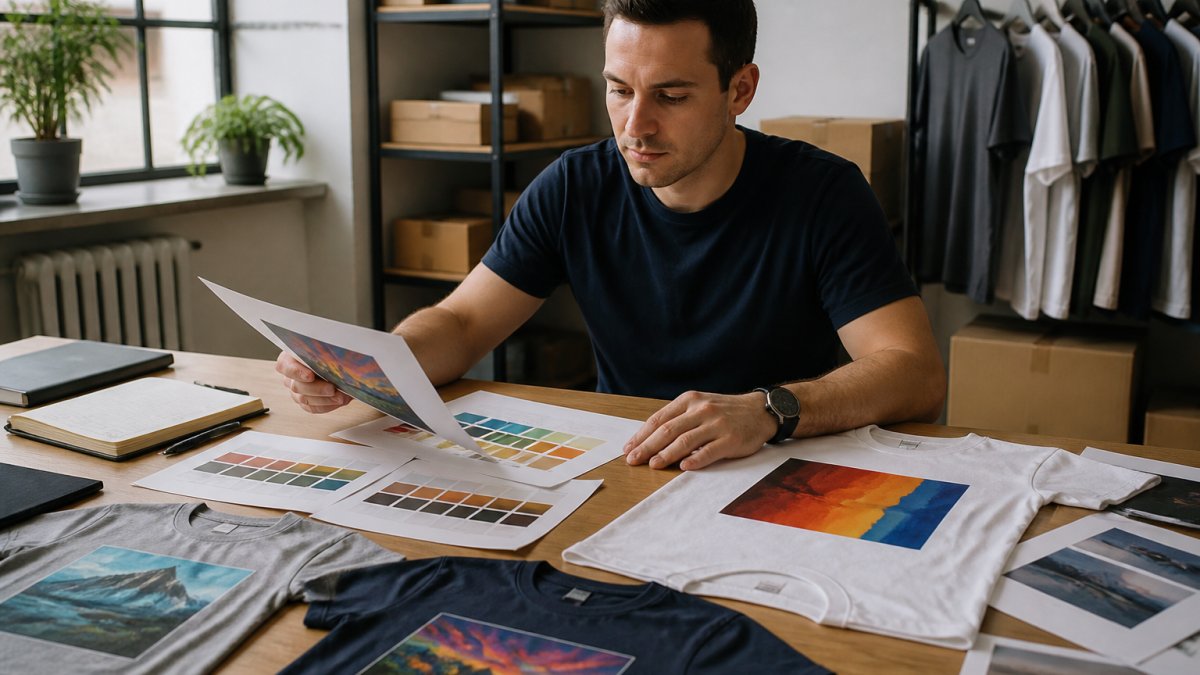
Step 1: Prepare your design specifications. Know exactly what you're ordering before you request quotes. Document:
- Design file (provide both digital and printed sample if possible)
- Number of colors in the design
- Placement on the shirt (front, back, sleeve)
- Shirt color and fabric type
- Exact quantity needed
- Target delivery date
Step 2: Request quotes from at least three vendors. Use identical specifications for each quote so you can compare apples to apples.
Step 3: Ask for itemized pricing. Request a breakdown that shows:
- Per-shirt cost
- Setup fees (if any)
- Artwork/design fees (if any)
- Total project cost
- Shipping cost
- Any rush fees or expedited options
Step 4: Compare total project cost, not per-shirt price. A vendor with higher per-shirt pricing might have lower setup fees, making them cheaper overall for your specific order size.
Step 5: Ask about samples. Most vendors can send sample shirts before you commit to the full order. Samples cost money but prevent expensive mistakes.
Step 6: Verify turnaround time. Confirm the production timeline and shipping timeline. Some vendors quote production time only; others include shipping. Know the difference.
Step 7: Check for hidden fees. Ask directly: "Are there any other charges I haven't accounted for?" Many vendors will mention fees you didn't think to ask about.
Quality Checks and Sample Orders
The cheapest option isn't valuable if the quality disappoints. Building quality checks into your process prevents costly reprints or unhappy recipients.
A sample order before full production is the gold standard. Order 5-10 shirts to inspect color accuracy, print durability, and shirt fit. This costs money upfront but saves money if you discover issues before printing 500 units.
When you receive samples, check:
- Color accuracy. Does the printed color match your design? Screen-printed colors look different from DTG colors. Compare to your original file.
- Print durability. Wash a sample shirt if it will be washed regularly. Does the print hold up? Screen-printed designs are more durable than DTG for frequent washing.
- Shirt quality. Is the fabric weight appropriate? Does the sizing run true to size? Check the seams and stitching quality.
- Print placement. Is the design positioned correctly? Is it straight? Is the size appropriate for the shirt?
For customers ordering bulk custom t-shirts for team events, teacher appreciation gifts, or family trips, requesting samples before full production is especially important.
Document any issues and communicate them to the vendor immediately. Most vendors will correct problems on the full order if you flag them during the sample phase.
Finding the cheapest way to print custom t-shirts in bulk requires understanding how different printing methods scale with order quantity. Screen printing wins for large orders with simple designs. Direct-to-garment printing offers flexibility for small orders and complex designs.
The real savings come from getting competitive quotes with identical specifications, accounting for all hidden costs, and ordering samples before committing to full production.
Frequently Asked Questions
What is the cheapest way to print custom T-shirts in bulk?
Screen printing typically offers the lowest per-shirt cost for bulk orders, especially when your design uses solid colors. As order volume increases, per-unit prices drop significantly, vendors like Broken Arrow Wear report that screen printing almost always delivers the best cost per shirt for large runs. For smaller orders under 50 shirts, print-on-demand services may be more economical since they eliminate setup fees. The cheapest approach depends on your order quantity, design complexity, and timeline.
How does screen printing bulk shirts compare to other printing methods in price?
Screen printing bulk shirts is often the most cost-effective method for large quantities. Direct-to-garment printing and print-on-demand services have higher per-unit costs but lower or no setup fees, making them better for smaller orders. Screen printing's advantage grows as your order size increases.
How many shirts do I need to order to get bulk pricing discounts?
Bulk pricing typically starts at a certain quantity, with meaningful discounts kicking in as order volume increases. However, the exact break-even point depends on your printing method and vendor. Screen printing often requires higher minimums to justify setup fees, while some platforms accept orders as small as 1 shirt. Request quotes at your target quantity to compare true total costs, not just per-unit prices.
What hidden costs should I watch for when ordering bulk custom T-shirts?
Common hidden costs include setup fees (especially for screen printing), artwork charges if your design needs professional preparation, shipping costs (which can add significantly to large orders), and rush fees for tight turnarounds. Some vendors quote per-shirt prices without including setup or design fees in the total. Always request an itemized quote that breaks down per-shirt cost, setup fees, design charges, and shipping. Compare total order cost, not just per-unit price, to identify the genuinely cheapest option for your specific order.