

Best Screen Printing Methods for Gifts: 2026 Guide
Table of Contents
- How to Match a Printing Method to the Gift You're Making
- Screen Printing vs. Heat Transfer for One-Off Gifts
- Screen Printing vs. Direct-to-Garment Printing for Photo Gifts
- Screen Printing Design Tips for Gift-Ready Artwork
- How to Screen Print a T-Shirt: Step-by-Step for Beginners
- Curing, Durability, and Care for Printed Gifts
- Cost and Turnaround by Order Size
- Frequently Asked Questions
Last Updated: October 8, 2026
How to Match a Printing Method to the Gift You're Making
Choosing the best screen printing methods for gifts starts with three questions: how many items are you making, what material are you printing on, and how much do you want to spend? At Urban Echo Tees, we offer custom T-shirts and sweatshirts perfect for birthdays, weddings, and school events. Get those three right and you avoid the two most common gift-printing mistakes: overpaying for a full screen setup on a single shirt, or choosing a method that fades fast.
Quantity, Substrate, and Budget: The Three Deciding Factors
Quantity decides whether a traditional screen is worth building. A screen takes time and materials to prepare, so it pays off across many prints and rarely makes sense for one.
Substrate decides which inks and techniques will bond. Cotton, blends, canvas totes, and synthetics all behave differently under the squeegee.
Budget decides how much setup you can absorb. Small gift runs favor low- or no-setup methods; larger batches reward screen printing's lower per-piece cost.
| Factor | What It Decides | Best Fit |
|---|---|---|
| Quantity | Whether a screen is worth building | Screen printing for batches, heat transfer for one-offs |
| Substrate | Which ink and technique will bond | Cotton and blends for screen printing, varied for transfer |
| Budget | How much setup cost you can absorb | Transfers for small runs, screens for volume |
| Personalization | Whether each item can differ | Transfer and DTG for unique pieces, screens for identical designs |
Screen Printing vs. Heat Transfer for One-Off Gifts
For a single gift, heat transfer usually beats screen printing. It applies a pre-made design with heat and pressure, so there is no screen to prepare and no minimum order. Screen printing shines when you need the same design on many items.
When Heat Transfer Beats a Full Screen Setup
Heat transfer wins when:
- You are printing one or two items, such as a personalized anniversary shirt
- The design has many colors, which would require several screens
- You want a name or date that changes from item to item
Screen printing still wins on durability and cost per piece at volume. For matching family or team shirts, the setup cost spreads across every print and the result holds up through repeated washing.
Screen Printing vs. Direct-to-Garment Printing for Photo Gifts
Direct-to-garment printing, or DTG, prints a design directly onto fabric like an inkjet printer. It handles detailed, full-color images, including photos, without screen prep, making it the stronger choice for photo gifts or designs with fine gradients.
Screen printing handles bold, limited-color designs best, laying down thicker ink that reads as more vibrant and lasts well on cotton. For photo gifts it struggles to reproduce smooth shading, and each color adds another screen.
Match the Method to the Gift Item, Not Just the Design
Most guides stop at "DTG for photos, screen printing for bold graphics." That breaks down the moment the gift is not a T-shirt. Here is how the decision shifts by item:
| Gift Item | Best Method | Why | Watch Out For |
|---|---|---|---|
| Cotton T-shirt or hoodie | Screen printing (batch) or DTG (one-off) | Plastisol and water-based inks bond well to cotton | DTG ink can fade faster on dark garments without a pretreatment |
| Canvas tote bag | Screen printing | Heavy canvas takes a thick ink deposit and holds registration | Unfinished canvas can wick ink; pre-wash or use a platen adhesive |
| Ceramic mug | Pad printing or sublimation, not screen printing | Curved, non-porous surface; screen printing needs a specialized cylindrical setup | Standard plastisol will not adhere to glaze, you need a ceramic-specific ink fired in a kiln |
| Photo frame, ornament, or flat paper good | Screen printing or sublimation | Flat surface, easy registration | Paper needs a slow-dry or UV ink; standard fabric ink will bleed |
| Metal tumbler or water bottle | Sublimation or UV-cured screen printing | Powder-coated metal accepts sublimation; bare metal needs a primer | Plastisol will peel off bare stainless steel |
| Glassware | Screen printing with a glass enamel ink | Enamel fuses to glass when fired | Air-dry glass inks scratch off in the dishwasher |
Substrate and Ink Compatibility
The biggest reason a printed gift fails is an ink-and-substrate mismatch, not a bad design. A few rules:
- Cotton and cotton blends: plastisol and water-based textile inks both work. Water-based inks feel softer and dye into the fiber; plastisol sits on top and gives a thicker, more opaque look.
- Synthetics (polyester, nylon, spandex): use low-bleed or dye-migration-blocking plastisol. Standard plastisol can pick up dye from the fabric and discolor over time.
- Canvas and heavy woven goods: a thicker ink deposit and a coarser mesh (around 110-160 threads per inch) push more ink into the weave.
Durability and Care by Method
Durability depends on the ink, the cure, and how the recipient treats the item.
- Screen-printed textiles: properly cured plastisol or water-based ink typically outlasts DTG through repeated washing. Cure plastisol at roughly 320°F for about 60 seconds; water-based inks need a longer dwell to fully cross-link.
- DTG prints: softer hand-feel but generally shorter lifespan, especially on dark garments. Wash inside out in cold water and skip the dryer to extend life.
- Sublimation on mugs and tumblers: the image is fused into the coating, so it resists fading and is usually dishwasher-safe, but only if the item is sublimation-coated to begin with.
Pass care instructions along with the gift. A card reading "wash inside out, cold, no dryer" does more for perceived quality than almost any design tweak.
One-Off Gifts vs. Batch Orders
Gift printing diverges most from commercial printing here. Screen printing is setup-heavy: each color needs its own screen, and building one takes time, emulsion, exposure, and cleanup. That setup is worth it across dozens of identical items and rarely for a single personalized piece.
- One or two items: heat transfer (vinyl or DTF), DTG, or sublimation. No screen, no minimum, fast turnaround.
- Three to ten items with the same design: DTG or transfers usually win on total cost unless the design is one or two colors and you already own the screens.
- Ten or more identical items: screen printing's per-piece cost drops below every alternative, and the durability is better.
Screen Printing Design Tips for Gift-Ready Artwork
Good gift artwork starts simple: a few bold colors, clear shapes, and no thin lines that can clog a mesh screen. A design that looks busy on a screen often prints muddy on fabric.
Prepare your image as a high-contrast graphic before it touches a screen. Solid color blocks separate cleanly; soft gradients and tiny text do not.
Color Separation and Registration on Small Runs
Color separation splits a design into individual color layers, one per screen; registration lines those layers up so they print in the right spot. On small gift runs both matter more, because a misaligned layer is obvious on a one-off item. Keep separations simple, fewer colors mean fewer screens to line up, and print a test on scrap fabric before the real gift item.
How to Screen Print a T-Shirt: Step-by-Step for Beginners
Here is the basic screen-printing process, start to finish:
Five Years Rooted 5th Anniversary T-Shirt →
- Prepare your artwork. Create a high-contrast design and separate it into color layers.
- Make the screen. Coat a mesh screen with light-sensitive emulsion and let it dry in the dark.
- Expose the screen. Place your transparency on the screen and expose it to light, then wash out the unexposed areas.
- Set up the shirt. Place the garment flat on the platen and line up the screen.
- Apply ink. Pull a squeegee across the screen to push ink through the open mesh onto the fabric.
- Cure the ink. Heat the printed area so the ink sets permanently.
- Repeat and check. Print the remaining items and inspect each one for alignment.
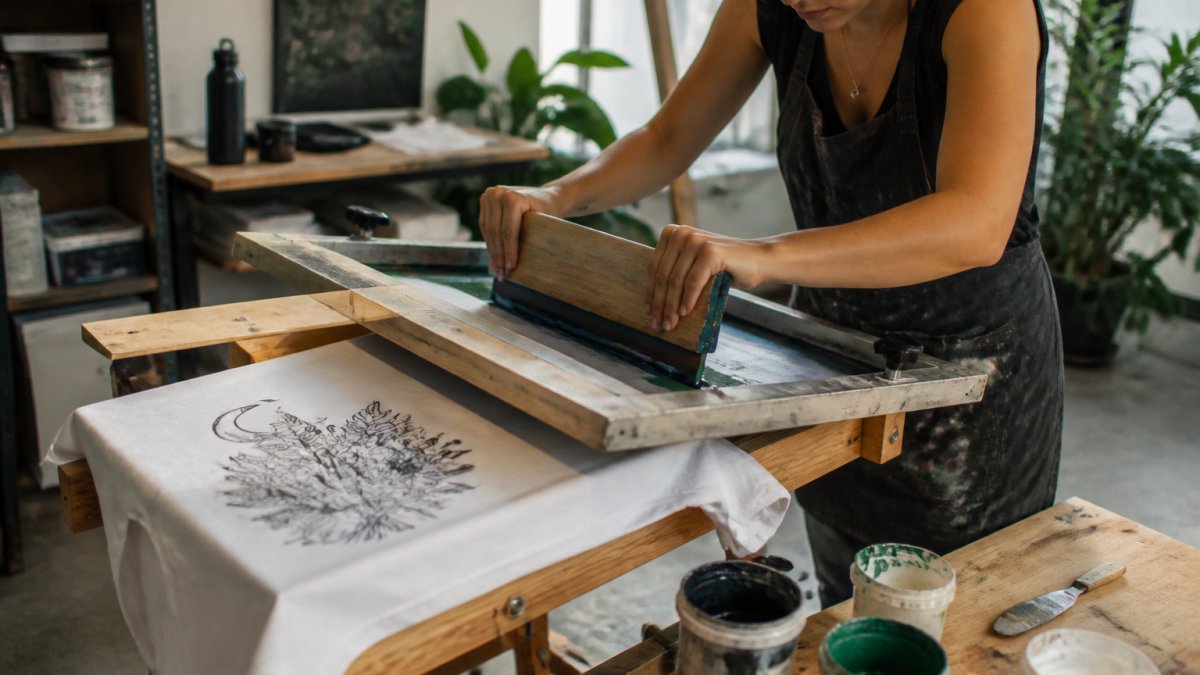
Expected result: a clean, even print that survives washing once the ink is fully cured. Follow the screen printing guidance from the U.S. Occupational Safety and Health Administration on ventilation when working with inks and solvents indoors.
Curing, Durability, and Care for Printed Gifts
Curing is what makes a print last. Until the ink reaches the right temperature it sits on the fabric and washes away; once cured, a screen-printed design can hold up for years of regular wear.
For gift durability, pass these care tips along with the item:
- Wash inside out in cold water
- Skip the dryer or use low heat
- Avoid ironing directly over the print
These habits keep both screen-printed and DTG designs looking newer longer. A gift that still looks good after a year says more than one that cracked in the first month.
Cost and Turnaround by Order Size
Cost per piece drops as quantity rises, because setup spreads across more items. A single heat-transfer gift carries no setup cost but a higher per-piece price; a large screen-printed run carries setup cost but a low per-piece price. The crossover point depends on your design's color count and method.
What Actually Drives the Cost
Four variables move the price of a printed gift more than anything else:
- Number of colors. Each color needs its own screen, emulsion exposure, and registration step, so setup cost roughly scales with color count.
- Screen setup. Emulsion coating, drying, exposure, and washout are fixed costs that only make sense across many prints.
- Ink and substrate. Specialty inks (low-bleed plastisol, ceramic enamel, sublimation coatings) and specialty substrates (mugs, tumblers, glass) cost more than standard textile ink and blank cotton.
- Quantity. Setup is fixed; per-piece cost falls as quantity rises.
Realistic Cost Ranges by Method
These are typical U.S. small-shop ranges for a one-color design on a standard cotton T-shirt. Treat them as planning benchmarks, not quotes.
| Method | Setup Cost | Per-Item Cost (1-2 items) | Per-Item Cost (12+ items) | Minimum Order |
|---|---|---|---|---|
| Heat transfer (vinyl) | None | $8-$15 | $5-$10 | None |
| DTF transfer | None | $6-$12 | $4-$8 | None |
| DTG | None | $15-$30 | $10-$20 | None |
| Screen printing | $20-$40 per screen | $15-$35 | $4-$10 | Often 6-12 pieces |
| Sublimation (mug) | None | $10-$20 | $6-$12 | None |
| Pad printing (mug) | $30-$75 per plate | $8-$18 | $4-$9 | Often 12-24 pieces |
A few patterns worth internalizing:
- Screen printing has the highest setup and the lowest per-piece cost at volume. For a single gift, that setup is wasted money.
- DTG and transfers have no setup but a higher floor. They win on small, personalized, or photo-heavy gifts.
- Sublimation suits mugs, tumblers, and polyester. No setup, durable, but only on coated or polyester surfaces.
Turnaround by Method
Turnaround follows the same logic as cost, more setup means longer lead time.
- Heat transfer and DTF: often same-day to 2 business days. No screen, no exposure, no washout.
- DTG: typically 1-3 business days, prepped and printed in one pass.
- Sublimation: 1-3 business days for flat goods; mugs and tumblers add press time per item.
If the gift has a hard deadline, a birthday, an anniversary, a wedding, build in a buffer. Screen printing and pad printing both have setup steps that cannot be rushed, and rush fees at most shops add 25-50% to the order.
The Gift-Specific Crossover
Here is the practical rule for gift projects:
| Order Size | Best Method | Why |
|---|---|---|
| 1-2 items | Heat transfer, DTF, or sublimation | No setup, fast turnaround, personalized designs are easy |
| 3-10 items | DTG or transfers | Low setup, flexible designs, reasonable per-piece cost |
| 10+ items, same design | Screen printing | Setup cost spreads, best per-piece price, best durability |
| 10+ items, each unique | DTG or transfers | Screen printing needs a separate screen per unique element |
| Mugs or tumblers | Sublimation (coated) or pad printing | Screen printing needs a cylindrical setup that most small shops lack |
For milestone gifts, our Five Years Rooted 5th Anniversary T-Shirt and matching sweatshirt are designed to celebrate five years of love and growth.
Safety and Environmental Notes for Home Gift Printing
If you are printing gifts at home rather than ordering from a shop, a few safety and environmental points matter:
- Ventilation: plastisol inks release fumes when cured. Work near an open window or use a fan pulling air away from your work area. The screen printing guidance from the U.S. Occupational Safety and Health Administration covers ventilation expectations for ink and solvent exposure.
- Skin contact: wear nitrile gloves when handling plastisol, screen wash, and emulsion remover. These are not skin-safe products.
- Cleanup: never pour screen wash or ink residue down a household drain. Collect it in a sealed container and dispose of it through your local household hazardous waste program.
For gifts, cost is rarely about the per-piece price alone, it is about whether the setup cost is justified by quantity. One shirt should almost never go through a screen. Twenty matching shirts almost always should.
Frequently Asked Questions
Is screen printing a good choice for personalized gifts?
It depends on the order size. Screen printing becomes cost-effective at roughly 12 or more identical items because the setup cost is spread across the run. For a single personalized gift, heat transfer or direct-to-garment printing usually makes more sense since there is no screen to burn. If you are ordering matching shirts for a group, screen printing delivers the most durable, vibrant result per dollar.
Which screen printing method works best for a small gift order?
For 8 to 15 items, a single-color or two-color screen print keeps setup manageable and per-unit pricing reasonable. If each item needs a different name or image, direct-to-garment printing avoids the need for separate screens. Batch orders of identical designs favor screen printing; personalized one-offs favor DTG or heat transfer.
How many colors should a screen-printed gift design use?
Each color adds a screen, a setup step, and a registration risk. One to three colors keeps small gift runs affordable and reduces misalignment. Bold single-color designs on a contrasting garment often look sharper than a four-color print on a low-volume order. If the design needs gradients or photographic detail, consider DTG instead.
How do you care for a screen-printed shirt or sweatshirt?
Wash inside out in cold water and tumble dry low or hang dry. Heat is what breaks down the cured ink film over time, so avoid hot water and high dryer settings. Skip fabric softener and bleach. Iron on the reverse side only, never directly on the print. With proper care, a cured screen print on cotton or a cotton-poly blend holds up for years.