

Best Custom T-Shirt Printing Services 2026
Table of Contents
- Best Custom T-Shirt Printing Services 2026: Quick Comparison
- How We Evaluated the Best Custom T-Shirt Printing Services
- Understanding Custom T-Shirt Printing Methods
- Key T-Shirt Printing Cost Factors to Know
- Custom T-Shirt Design Tips for Best Results
- Print-on-Demand T-Shirt Companies: When to Use Them
- Where Each Service Wins: Use-Case Recommendations
- Common Mistakes When Choosing a Custom T-Shirt Printing Service
Last Updated: July 27, 2026
Finding the right best custom t-shirt printing service 2026 can feel overwhelming when juggling design quality, turnaround time, and pricing. Whether you're ordering 5 shirts for a family reunion or 500 for company branding, the printing method and service you choose directly impacts your finished product. At Urban Echo Tees, we've helped customers navigate these decisions for personalized gifts and special events, and we've learned what separates mediocre printing from results that match your vision.
This guide breaks down the best custom t-shirt printing service options available in 2026, comparing printing methods, cost factors, and real-world use cases so you can make a decision that fits your timeline and budget.
Best Custom T-Shirt Printing Services 2026: Quick Comparison
| Service Type | Best For | Typical Turnaround | Price Range | Minimum Order |
|---|---|---|---|---|
| Screen Printing | Bulk orders, solid colors | 5-7 business days | Lower per-unit cost | 25-50 shirts |
| Direct-to-Garment (DTG) | Small orders, photo designs | 3-5 business days | Higher per-unit | 1-5 shirts |
| Heat Transfer | Quick orders, detailed graphics | 2-3 business days | Moderate | 5-10 shirts |
| Print-on-Demand | Flexible quantities, no minimums | 7-10 business days | Variable | 1 shirt |
| Urban Echo Tees | Personalized gifts, special occasions | 5-7 business days | Competitive | 1-20 shirts |
How We Evaluated the Best Custom T-Shirt Printing Services
Choosing the best custom t-shirt printing service 2026 requires looking beyond price. We examined services based on five core criteria: printing method quality, minimum order requirements, turnaround time, design customization support, and customer experience.
Printing Method Quality: Different techniques produce different results. Screen printing delivers vibrant, long-lasting colors on solid designs but requires minimum orders. Direct-to-garment printing handles complex, photo-quality designs on small orders but costs more per shirt. Heat transfer offers a middle ground for detailed graphics with lower minimums.
Minimum Order Requirements: Many traditional printers demand 25-50 shirt minimums, which doesn't work for small orders like teacher appreciation gifts or family trips. Services accepting 1-5 shirt orders serve a different market entirely.
Turnaround Time: Services offering 3-5 day standard turnaround without premium fees are more valuable than those charging 50% extra for faster delivery.
Design Customization Support: Some services provide free design consultation and unlimited revisions. Others charge per revision and offer minimal guidance. This difference compounds when ordering gifts and wanting the design perfect.
Customer Experience: Transparent communication, easy reordering, and responsive customer support matter more than price alone when something goes wrong.
Understanding Custom T-Shirt Printing Methods
The printing method you choose determines everything about your final product: durability, color accuracy, design complexity, and cost.
Screen Printing vs. Direct-to-Garment vs. Heat Transfer
Screen printing is the traditional method. A screen is created for each color in your design, and ink is pushed through onto the shirt. This works beautifully for designs with 1-4 solid colors and large order quantities. The setup cost is high, but per-shirt cost drops dramatically as order size increases. A 100-shirt order costs far less per shirt than a 5-shirt order, which becomes prohibitively expensive.
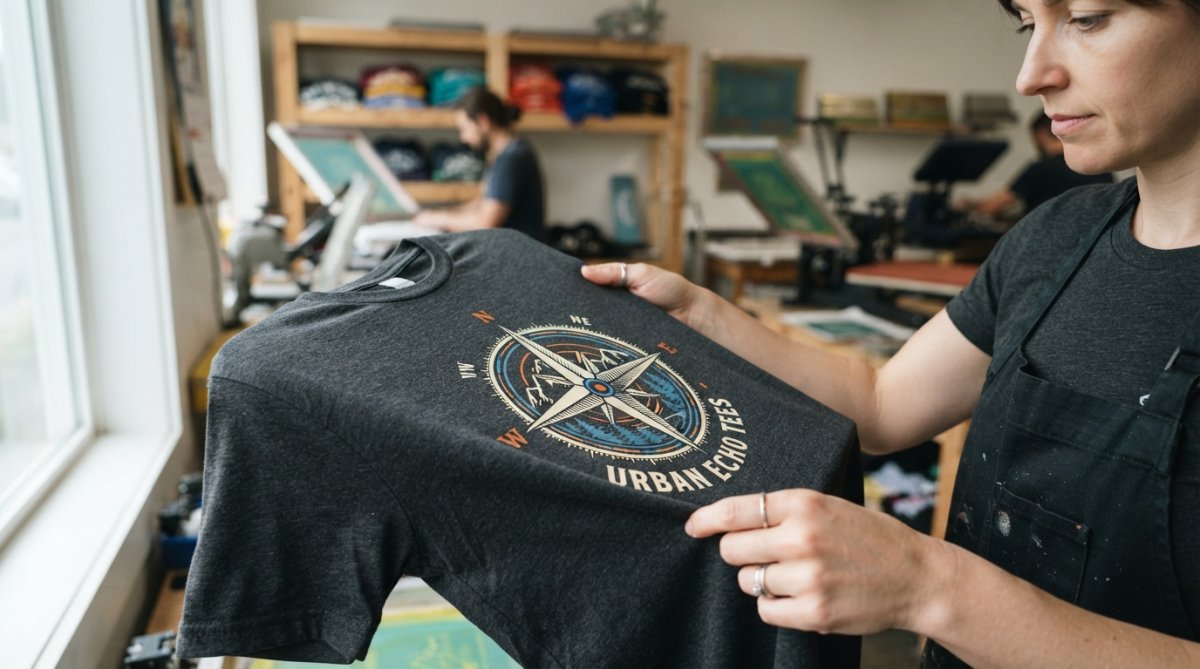
Direct-to-garment (DTG) printing works like an inkjet printer for fabric. The design is printed directly onto the shirt using specialized inks. This method handles unlimited colors, photo-quality images, and small orders without setup fees. The trade-off: per-shirt cost stays high even at large quantities, and the print may feel slightly stiffer than screen printing.
Heat transfer uses a vinyl or printed transfer pressed onto the shirt with heat. This approach splits the difference. It handles detailed, multi-color designs without screen setup costs, works for small orders, and produces decent durability. The design texture is noticeable to the touch, which some prefer and others find less professional.
Print quality also depends on shirt material. 100% cotton absorbs ink differently than cotton-poly blends. Professional printers account for this; budget services often don't.
Key T-Shirt Printing Cost Factors to Know
The price you see advertised rarely matches what you'll actually pay.
Quantity discounts matter exponentially. A single shirt might cost $25 to print. Ten shirts might be $12 each. Fifty shirts might be $6 each. This is why bulk orders feel so much cheaper per unit.
Setup and design fees vary wildly. Some services include unlimited free design revisions. Others charge $25-50 per revision. Some charge a one-time setup fee of $50-100, while others build it into the per-shirt cost.
Shirt quality affects price. A basic $3 blank shirt prints for less than a premium $8 shirt. For gifts, shirt quality matters as much as print quality. Cheap blanks shrink unpredictably and fade faster.
Rush fees add up fast. Standard 5-7 day turnaround is usually included in the quoted price. Jumping to 2-3 day turnaround often adds 20-50% to the total cost.
Color complexity increases cost for some methods. Screen printing charges per color. A 4-color design costs significantly more than a 1-color design. DTG pricing doesn't change with color count, making it better for photo designs.
Custom T-Shirt Design Tips for Best Results
The best printing service can't fix a poorly designed file. Getting your design right before you order prevents expensive reprints.
Resolution matters. A design that looks fine on your screen at 72 DPI will appear pixelated on a printed shirt. Use 300 DPI minimum. This is especially critical for DTG printing, which shows every pixel.
Color matching is harder than expected. Your screen displays colors in RGB, but printers use CMYK. What looks like bright blue on your monitor might print as darker, more muted blue. Professional services provide color swatches. Request them before ordering large quantities.
Font choice affects legibility. Thin, delicate fonts disappear at small sizes. Thick, bold fonts with good contrast print cleanly. Test small text first or use a service that offers free proofs.
Placement and sizing determine visual impact. A design that looks great at 6 inches wide might overwhelm the shirt at 12 inches or disappear at 3 inches. Ask your printer for placement recommendations. Most services provide digital mockups.
Transparency and gradients behave differently per method. Screen printing can't handle true transparency. DTG handles it beautifully. Heat transfer falls in between. Confirm your method supports your design before finalizing.
Print-on-Demand T-Shirt Companies: When to Use Them
Print-on-demand services like Printful, Teespring, and Merch by Amazon eliminate minimum orders and upfront costs. You design once, and customers order directly from your store.
These services work well for testing designs before bulk ordering, selling limited-edition designs without inventory risk, or building a personal brand with minimal investment. The per-shirt cost is higher than bulk printing, but you only pay for what sells.
The downside: turnaround times are longer (7-14 days), design customization is limited, and quality varies by vendor.
Print-on-demand makes sense if you're exploring whether a design will sell. It doesn't make sense if you need 50 shirts for an event in two weeks or want to control every aspect of the final product.
Where Each Service Wins: Use-Case Recommendations
Different scenarios demand different solutions.
Best for Small Orders Under 20 Shirts
Urban Echo Tees specializes in this exact scenario. Small orders for family trips, teacher appreciation events, weddings, and personalized gifts represent most of their business. They accept orders as small as 1-5 shirts without charging exorbitant per-unit premiums.
For orders under 20 shirts, DTG printing or heat transfer typically delivers the best value. Screen printing's setup costs make it prohibitively expensive at this volume. Urban Echo Tees' focus on personalized gifts for specific occasions means they've optimized their process for exactly this use case.
The key advantage: no pressure to order larger quantities to hit a better price.
Best for Fast Turnaround (Under 2 Weeks)
Heat transfer printing offers the fastest standard turnaround: 2-3 business days for most services. This method requires no screen setup and minimal pre-press work.
If you need shirts in 5-7 days, screen printing is feasible with a service offering quick turnaround. DTG printing averages 3-5 days and works well for complex or multi-color designs.
Print-on-demand services typically require 7-10 days minimum, making them unsuitable for rush situations.
Best for Bulk Orders and Team Apparel
Screen printing dominates for orders of 50+ shirts. At this volume, per-shirt cost drops to $4-8 depending on design complexity and shirt quality. No other method comes close.
For 50-100 shirt orders, screen printing's 5-7 day turnaround is standard. Team apparel orders often benefit from bulk discounts and the ability to do multiple design variations.
Common Mistakes When Choosing a Custom T-Shirt Printing Service
Mistake 1: Choosing based on price alone. The cheapest service often has hidden fees, poor communication, or quality issues. A service 15% more expensive but transparent and reliable costs less overall when you factor in reprints and revisions.
Mistake 2: Not confirming color accuracy before ordering large quantities. Your design looks one way on your screen and potentially very different on the finished shirt. Request a physical swatch or digital mockup before committing to 100 shirts.
Mistake 3: Underestimating turnaround time. "5-7 business days" doesn't mean you'll have shirts in a week. Add 2-3 days for shipping and account for weekends. Order at least 2 weeks in advance unless paying rush fees.
Mistake 4: Uploading low-resolution files. A design that looks fine on your phone will print pixelated on a shirt. Confirm your file is at least 300 DPI before uploading.
Mistake 5: Not reading the sizing chart. Custom t-shirt sizing varies between manufacturers. Check actual measurements, not just size labels.
Mistake 6: Ordering without understanding the printing method. Each method has different strengths. Ordering 10 shirts via screen printing costs way more than DTG. Ordering 200 shirts via DTG costs way more than screen printing.
Choosing the best custom t-shirt printing service 2026 comes down to matching your specific needs, order size, timeline, design complexity, and budget, to the right service. For personalized gifts and small orders, Urban Echo Tees offers curated custom t-shirts and sweatshirts designed specifically for meaningful moments like weddings, teacher appreciation, and family trips. Their specialized focus on occasion-based apparel means they've optimized for exactly what most small-order customers need. Explore Urban Echo Tees to see how their approach to custom apparel can simplify your next order.
Frequently Asked Questions
What is the best custom t-shirt printing method for small orders?
For small orders (under 20 shirts), direct-to-garment (DTG) and heat transfer printing are ideal because they don't require expensive setup fees or minimum quantities. DTG offers vibrant colors and photographic detail, while heat transfer works well for simple designs. Screen printing requires higher minimums but delivers superior durability for larger runs. Choose based on your design complexity and budget rather than order size alone.
What factors should I consider when choosing a custom t-shirt printing service?
Key factors include minimum order quantities, turnaround time, printing method quality, pricing structure, color accuracy (how screen previews match final products), sizing options, return/exchange policies, and customer support responsiveness. Consider whether you need fast shipping, design assistance, or specialty items like sweatshirts. Compare how each service handles small personal orders versus bulk team orders, different services excel in different scenarios.
How do custom t-shirt printing cost factors affect my total price?
Pricing depends on quantity, design complexity, printing method, shirt quality, color count, and delivery speed. Per-unit costs typically decrease significantly with larger orders. Rush delivery adds substantial premiums. Some services charge setup or artwork fees; others include them. Request quotes from multiple providers for your specific order size and timeline, a service cheap for 100 shirts may be expensive for 10, and vice versa.
What should I know about print-on-demand t-shirt companies before ordering?
Print-on-demand companies handle production and shipping automatically, ideal for one-off gifts or avoiding inventory. However, per-unit costs are higher than bulk printing services. Quality varies by vendor and printing method. Lead times are typically 5-10 business days plus shipping. They excel for small personal orders but cost more per shirt, making them less economical for groups or bulk team apparel.
How can custom t-shirt design tips ensure my print looks good on the final shirt?
Use high-resolution artwork (300 DPI minimum), choose colors with good contrast against your shirt color, and avoid fine details that may blur in printing. Preview your design on the actual shirt color in the service's tool, screen colors differ from printed results. Keep important design elements away from seams and edges. Verify color accuracy by requesting a sample or checking customer reviews. Ask your printer about color limitations for your chosen printing method.
This article was written using GrandRanker