

Benefits of Custom Shirts for Staff Team Building
Table of Contents
- Why Custom Shirts Work for Team Building
- The Psychology of Shared Apparel
- 1. Building Team Spirit and Employee Unity
- 2. Boosting Workplace Morale and Employee Confidence
- 3. Creating a Professional, Coordinated Appearance
- 4. Increasing Brand Awareness and Visibility
- 5. Supporting Customer Recognition and Trust
- Company Team-Building Shirt Ideas That Actually Get Worn
- Staff Shirt Design Ideas: From Logo to Lifestyle
- What Most Guides Get Wrong
- Frequently Asked Questions
Last Updated: October 4, 2026
Why Custom Shirts Work for Team Building
The benefits of custom shirts for staff team building show up in two places: internally, where employees feel more connected, and externally, where customers see a coordinated team and read competence into it.
The psychology is straightforward. Social identity theory holds that people define part of who they are through the groups they belong to, and a shirt is one of the cheapest, fastest ways to make that membership visible.
Below, we break down the five benefits that matter most, plus guidance on design, comfort, and getting shirts people will actually wear again.
The Psychology of Shared Apparel
Shared apparel works because it turns an abstract team into something you can see. When everyone wears the same logo shirt, the group stops being a concept in an org chart and becomes a visual fact.
A second mechanism is "enclothed cognition", what a person wears can influence their own psychological state, not just how others perceive them (pubmed.ncbi.nlm.nih.gov).
A third mechanism is small public commitments.
Why This Matters for Team Building Specifically
Team-building activities often fail because their effects fade as soon as the event ends. A shared shirt keeps working after the room clears: it stays in the employee's closet, gets worn on weekends, and reactivates the group identity every time it comes out.
That persistence is the difference between a shirt and a one-day retreat: the retreat creates a memory; the shirt keeps it in circulation.
1. Building Team Spirit and Employee Unity
Team spirit is the first and most obvious benefit. Matching custom T-shirts give employees a shared symbol, and shared symbols build unity faster than most formal activities.
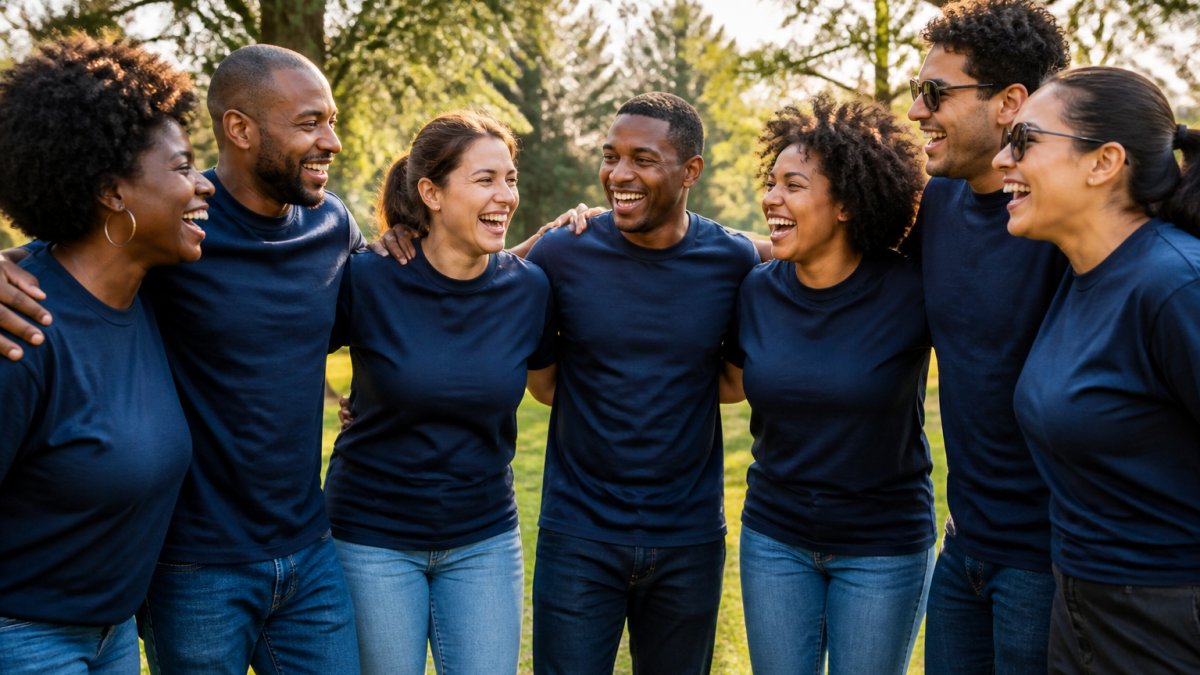
The effect is strongest when shirts are tied to a specific moment: a launch, a retreat, a volunteer day, a holiday party. The shirt becomes a souvenir of that shared experience, and wearing it later reactivates the memory.
From Individual to Collective Identity
A staff member who puts on a company shirt signals something to themselves as much as to anyone else. The shift from "I work here" to "I'm part of this" happens in small steps, and apparel is one of them.
Group activities amplify this. When a team wears matching shirts to a volunteer event or company picnic, the visual uniformity reinforces that everyone is contributing to the same thing, team cohesion in its simplest form.
2. Boosting Workplace Morale and Employee Confidence
Workplace morale improves when employees feel seen and included. A well-designed shirt does both: it acknowledges the person as part of the group and gives them something comfortable they chose to put on.
The morale lift isn't magic. Employees get a small gift, a reason to feel proud of where they work, and a conversation starter with coworkers they might not otherwise talk to.
The Confidence Factor
Confidence gets a boost from the same source: a person wearing a shirt that represents a team they're proud of stands a little taller. New hires benefit most, because the shirt signals "you're one of us" before they've proven it through their work.
The catch: this only works if the shirt is comfortable and fits well. A scratchy, ill-fitting shirt produces the opposite effect. We'll cover sizing and comfort later.
3. Creating a Professional, Coordinated Appearance
A coordinated look reads as competence. When a customer sees three employees in matching logo shirts, the immediate impression is an organized operation, not a loose collection of individuals.
This matters most for customer-facing teams, retail staff, event crews, service technicians, front-desk employees. A uniform look removes the guesswork about who works there and who doesn't.
The benefit extends beyond the workplace: employees wearing branded apparel at a conference, trade show, or community event represent the company well and look like they belong there.
4. Increasing Brand Awareness and Visibility
Every shirt worn in public is a small piece of marketing, a benefit most business owners understand, but the scale is worth spelling out.
Turning Staff into Walking Advertisements
A staff member running errands on a Saturday is a walking advertisement, whether they intended to be or not. The logo on their chest reaches people ads never would: neighbors, fellow parents at a soccer game, people in line at the grocery store.
Brand recognition builds through repetition: seeing the same logo on different people in different places creates familiarity, the first step toward customer trust. For small businesses, this passive visibility is one of the most cost-effective forms of marketing available.
5. Supporting Customer Recognition and Trust
Customers trust what they can identify. A recognizable logo shirt tells a customer "this person is authorized to help you," reducing hesitation at the moment it matters.
For service businesses, this is a safety issue as much as a marketing one: a homeowner opening the door to a technician in a branded shirt feels more secure than one facing a stranger in plain clothes, and that trust means smoother interactions and fewer complaints.
What Trust Actually Looks Like on the Ground
The trust benefit shows up in a few specific places that are worth watching for:
- Faster identification in busy settings. In a retail floor, a trade show booth, or a crowded event, a customer scanning for help spots the logo before they spot a face. That shortens the gap between "I need something" and "I found someone."
- Fewer verification questions. When a service technician arrives in a branded shirt, the customer spends less time confirming who they are and more time on the actual work.
- Consistent experience across staff. When every team member wears the same shirt, customers stop associating quality with one specific employee and start associating it with the business.
Measuring Whether It's Working
Most guides stop at "customers trust logos" and never say how to tell if it's true for your team. Pick one or two signals before you order and track them for a quarter:
- Customer comments. Ask front-line staff to note when a customer mentions the shirt, asks about the team, or references the logo. Even a handful of mentions in a month is a signal.
- Identification speed at events. At a trade show or community event, count how often attendees approach a staff member unprompted versus how often staff have to initiate. A shift toward unprompted approaches suggests the shirts are doing their job.
- Repeat recognition. Track whether returning customers reference the team or the logo in follow-up interactions. This is informal, but it's the kind of signal that shows up in a customer's own words.
- Complaint and confusion rates. If customers were previously confused about who worked there, that confusion should drop after shirts are introduced. Front-desk and service teams usually notice this within a few weeks.
None of these require a formal survey. A shared note in a team channel is enough. The point is to replace "we think it helps" with "here's what we noticed."
Where the Trust Effect Is Weakest
The trust benefit is not automatic, it depends on the shirt looking intentional. A faded, cracked, or obviously cheap shirt undercuts the professionalism it's supposed to signal, so print durability and fabric quality matter more for customer-facing teams. If customers see it daily, it must hold up to repeated washing and wear.
FTC guidance on endorsements and advertising claims
Company Team-Building Shirt Ideas That Actually Get Worn
The best team-building shirt gets worn more than once. If it ends up in a drawer after the event, you've paid for a one-day item; if it becomes a favorite, you've paid for years of brand visibility.
Here's what separates the two:
| Design Choice | Gets Worn Again | Gets Left in the Drawer |
|---|---|---|
| Fit | True-to-size, relaxed | Boxed, tight, or oddly cut |
| Fabric | Soft cotton or cotton blend | Stiff, scratchy, heavy |
| Design | Small logo, clean layout | Oversized logo, busy text |
| Color | Neutral or brand-adjacent | Loud, clashing, or dated |
| Occasion | Tied to a real moment | Generic, no story |
Designing for Comfort and Inclusion
Inclusion matters more than most guides admit. A shirt that fits only one body type excludes part of the team, and exclusion is the opposite of team building.
Offer a real size range, including extended sizes, and a fabric that works across seasons. Skip gendered cuts unless you offer both. The goal is a shirt every team member can put on without thinking about it.
Staff Shirt Design Ideas: From Logo to Lifestyle
Design choices determine whether a shirt becomes a favorite or a dust collector. The strongest designs fall into a few categories.
- Small chest logo, no back print: The most versatile option. Works for any setting, from the office to the grocery store.
- Event-specific front design: Great for a retreat, launch, or holiday party. Dates the shirt, but that's the point.
- Inside-joke or team slogan: Builds cohesion fast, but only if the joke lands for everyone on the team.
- Minimal text, strong color: Reads as a lifestyle brand rather than corporate merch, which makes it more likely to get worn outside work.
Choosing Colors and Printing Methods
Color choice is where most teams make their first mistake: logo colors may not translate to fabric, and screens display color differently than a printer produces it. Always request a physical proof or mockup on the actual shirt color before approving a run.
Printing method matters for longevity.
What Most Guides Get Wrong
Two things get skipped in almost every article on this topic: measurement and follow-through.
The second gap is planning for replacement. Shirts wear out, people join, sizes change. Build a small buffer into your first order and keep the design file on hand so reorders are fast. A team-building program that runs once and never again isn't a program.
Building a team culture that lasts takes more than one event, and the apparel you choose either supports that work or sits in a drawer.
Frequently Asked Questions
How do team shirts help employees feel connected?
Team shirts create a shared visual identity that reminds employees they are part of something bigger than their individual role. When everyone wears the same custom shirts, it levels the playing field between departments and job titles. The key is choosing shirts people actually want to wear outside of mandatory events.
What should you put on staff team-building shirts?
Start with your company logo on the chest or sleeve, then add a phrase that reflects your internal culture rather than a generic slogan. Employee names or nicknames on the back work well for smaller teams. Avoid dates or event-specific text if you want the shirts to stay in rotation. For company team-building shirt ideas, consider inside jokes, department names, or a mission statement shortened to five words or fewer. The goal is a design that feels like a reward, not a requirement.
How can a company design shirts employees will want to wear?
Let employees vote on two or three staff shirt design ideas before you order. Choose soft, breathable fabrics and use printing methods that do not crack after a few washes. Comfort and choice drive voluntary wear.
Are custom team shirts for employees worth the investment?
Yes, when you treat them as part of your employee experience rather than a one-time event expense. Custom team shirts for employees improve brand visibility every time someone wears one in public, and they reinforce team unity during meetings, events, and casual Fridays. Budget for replacements and new hires so the program stays consistent. Measure success by tracking voluntary wear, asking for feedback, and watching whether employees request shirts for outside events. If people wear them without being asked, the investment is working.